Florida E-Bike Laws: Classes, Where You Can Ride, and Rules (2026 Guide)
Florida treats electric bicycles as bicycles, not motor vehicles—provided they meet the state’s definition. That single distinction determines everything else: no tag, no title, no insurance requirement, and access to bike lanes and multi-use paths.
But the law draws a hard line at 20 mph and 750 watts. Cross it, and your ride stops being an e-bike and starts being a moped or motor vehicle, with entirely different rules. Here’s the breakdown.
The Three Legal Classes in Florida (FS 316.003)
Florida law recognizes three e-bike classes. The class is determined by how the motor engages and its top speed, not by the bike’s appearance.
| Class | Motor Engagement | Max Assisted Speed | Throttle Allowed? |
|---|---|---|---|
| Class 1 | Pedal-assist only | 20 mph | No |
| Class 2 | Throttle or pedal-assist | 20 mph | Yes |
| Class 3 | Pedal-assist only | 28 mph | No |
Key details:
- Class 1 is the most widely permitted option. Since the motor only helps while you pedal, many municipalities and homeowner associations treat it like a standard bicycle.
- Class 2 allows a throttle that can move the bike without pedaling, but the motor must cut out at 20 mph.
- Class 3 is for higher-speed commuting. The motor assists up to 28 mph, but only when pedaling. Florida law requires Class 3 riders to be at least 16 years old.
The 750-watt ceiling: All three classes must have a motor of 750 watts (1 horsepower) or less. If your motor exceeds that, the vehicle is legally something else—typically a moped or motorcycle.
The label requirement: Florida law requires every e-bike to have a permanently affixed label stating its class number and top assisted speed. If you bought a bike without one, or the label has worn off, contact the manufacturer for a replacement before riding. Law enforcement uses that label to determine what you’re operating.
Moped vs. E-Bike: The Line That Changes Everything
This is the most common point of confusion, and the consequences of getting it wrong are significant.
An e-bike (per FS 316.003):
- Has pedals that operate normally
- Has a motor of 750 watts or less
- Cannot exceed 20 mph on motor power alone (Class 2) or 28 mph with pedaling (Class 3)
A moped (per FS 316.003):
- Has pedals or a motor that can propel it without pedaling
- Cannot exceed 30 mph on level ground
- Has an engine of 50cc or less (if combustion) or 2 brake horsepower or less (if electric)
The practical test: If your electric bike has a throttle and can exceed 20 mph on throttle alone, it’s a moped in Florida. A Class 2 bike that’s been modified to hit 28 mph on throttle no longer qualifies as an e-bike.
What changes if it’s a moped:
- You must register it with the Florida DMV (title and tag required)
- You must have a valid driver’s license (any class)
- You must carry insurance (minimum $10,000 PIP and $10,000 property damage liability)
- You must wear a DOT-approved helmet
- You cannot ride on sidewalks or bike paths designated for bicycles
- You must follow motorcycle lane positioning rules
The modification warning: Removing a speed limiter or upgrading the controller to push past 20 mph on throttle automatically reclassifies your bike. This isn’t a gray area—the law is based on the vehicle’s actual capability, not its original factory settings.
How to verify your bike’s status before you ride:
1. Check the manufacturer’s label for class and wattage.
2. Test the throttle on a flat, empty stretch: if the bike exceeds 20 mph on throttle alone, it’s legally a moped.
3. If you’re unsure whether a modification pushed you over the line, call a Florida DMV office and describe the bike’s specs. They’ll tell you how it’s classified.
The branch point: If the throttle test shows the bike topping out at exactly 20 mph, you’re still legal—but only if the motor cuts out there. If it creeps past 20 mph even slightly, stop riding it on public roads until you restore the limiter or register it as a moped. The difference between 19.9 mph and 20.1 mph is the difference between a bicycle and a motor vehicle in Florida.
Registration, License, and Insurance: What You Don’t Need
For a true Class 1, 2, or 3 e-bike, Florida law is explicit:
- No registration with the DMV
- No license plate or title
- No driver’s license required (except Class 3 riders must be 16+)
- No insurance required
- No VIN requirement
This applies to e-bikes used on public roads, bike lanes, and multi-use paths. You do not need a motorcycle endorsement, and you do not need to insure the bike.
One caveat: If you finance an e-bike, the lender may require insurance to protect their collateral. That’s a contractual requirement, not a legal one.
The enforcement reality: If a police officer stops you on a bike that looks modified—oversized motor, no pedals, or obvious speed capability—they can measure the bike’s capability and reclassify it on the spot. A stock e-bike with a visible class label is rarely questioned. A bike with the label removed and a non-standard controller is a magnet for enforcement.
Where You Can Ride in Florida
Roads and Bike Lanes
E-bikes have the same rights and duties as bicycles on Florida roads. That means:
- You may ride in bike lanes where provided
- You may ride on the roadway (right side, with traffic)
- You may take the full lane when the lane is too narrow to share safely with a car
- You may use “roadable” shoulders
Speed consideration: In a bike lane, you’re still subject to the posted speed limit for that road. A Class 3 bike doing 28 mph in a 25 mph zone is speeding, even though the bike is legally capable of that speed.
Sidewalks
There is no statewide law prohibiting e-bikes on sidewalks. However, Florida law gives local governments authority to regulate this, and many cities and towns have done so.
- Miami Beach: E-bikes are prohibited on the boardwalk and beachwalk. Sidewalk riding is restricted in the South Beach area.
- Key West: E-bikes are allowed on sidewalks but must yield to pedestrians and obey a 15 mph speed limit in certain zones.
- Orlando: E-bikes are prohibited on sidewalks in the downtown core.
- St. Augustine: E-bikes are banned from the historic district sidewalks.
The general rule: If a city has a bicycle ordinance, check whether it distinguishes between “bicycles” and “electric bicycles.” Many older ordinances only regulate bicycles, leaving e-bikes in a gap. When in doubt, ride on the road.
Multi-Use Paths and Trails
Florida’s shared-use paths (like the Pinellas Trail, Legacy Trail, or Shark Valley) generally allow Class 1 and Class 2 e-bikes. Class 3 bikes are frequently restricted because of their higher speed.
Before you ride any trail, check the managing agency’s rules:
- Florida State Parks: Allow Class 1 and Class 2 e-bikes on trails where traditional bikes are allowed. Class 3 is prohibited.
- South Florida Water Management District (SFWMD) trails: Allow Class 1 and Class 2. Class 3 requires special permission.
- Local rail-trails: Varies by county. Some allow all classes; others restrict Class 3.
The practical pattern: If a trail allows “electric bicycles,” it usually means Class 1 and Class 2. If it says “Class 1 only,” that’s explicit. Class 3 access is the exception, not the rule.
The trailhead check: Most Florida trails post class restrictions at the entrance. If you don’t see a sign, check the managing agency’s website before riding. A quick search for “[trail name] e-bike policy” will usually give you a definitive answer in under two minutes.
Beaches
No Florida beach allows motorized vehicles on the sand, and e-bikes are generally treated as motorized vehicles on beaches. This includes:
- Daytona Beach (where cars are allowed on hard-packed sand, but e-bikes are not)
- Clearwater Beach
- Siesta Key Beach
- Fort Lauderdale Beach
The exception: Some beachside paved paths (like the Hollywood Beach Broadwalk) allow e-bikes but restrict them to walking speed in crowded areas. Always check local signage.
Age and Helmet Requirements
| Requirement | Class 1 | Class 2 | Class 3 |
|---|---|---|---|
| Minimum age to ride | None specified | None specified | 16 years old |
| Helmet required | No (under 16 must wear one) | No (under 16 must wear one) | Yes, all riders |
The helmet nuance: Florida’s bicycle helmet law requires anyone under 16 to wear a helmet when riding a bicycle—and that includes e-bikes. For Class 3, the helmet requirement applies to everyone regardless of age.
Helmet standard: Florida law doesn’t specify a helmet standard for e-bikes, but a CPSC-certified bike helmet is the minimum. For Class 3 riding at 28 mph, consider a helmet rated for higher-impact speeds.
The parent’s decision point: If you’re buying an e-bike for a rider under 16, a Class 3 is off the table entirely. For Class 1 and Class 2, the rider must wear a helmet, but there’s no minimum age specified in state law. However, some cities have set their own minimum ages—check your local ordinance before letting a young teen ride.
Local Restrictions: The Patchwork You Need to Know
Florida’s 67 counties and 400+ municipalities can pass their own e-bike ordinances, as long as they don’t conflict with state law. This creates a patchwork of rules that can change at city limits.
Common local restrictions:
- Sidewalk bans in downtown and tourist districts
- Speed limits on shared paths (often 15 mph)
- Age requirements higher than state law
- Noise restrictions (rarely an issue with e-bikes, but some cities have decibel limits)
- Parking restrictions (some cities require e-bikes to use motorcycle parking, not bike racks)
High-enforcement areas to know:
- Miami-Dade County: Enforces sidewalk restrictions aggressively in Miami Beach and Coral Gables. Fines start around $50.
- Tampa: Downtown e-bike riders have been cited for riding on sidewalks in the Channel District.
- Fort Lauderdale: The beach promenade has a 10 mph speed limit for all bicycles and e-bikes.
The rule that applies everywhere: If a local ordinance directly conflicts with state law, state law generally prevails. But most local rules don’t conflict—they fill gaps the state left open, like sidewalk access and trail speeds.
The escalation signal: If you’re stopped by law enforcement and the officer tells you you’re violating a local rule you can’t find in writing, ask for the specific ordinance number. Legitimate local restrictions are codified and searchable. If the officer can’t provide one, you may be dealing with an informal policy rather than a law—but that’s not an argument to have on the street. Note the officer’s name and badge number, comply, and contest it later if needed.
Penalties for Violations
Most e-bike violations in Florida are civil infractions, not criminal offenses.
| Violation | Typical Fine | Notes |
|---|---|---|
| Riding an unregistered moped (modified e-bike) | $100–$500 | Vehicle may be impounded |
| No helmet (Class 3 or under 16) | $30–$60 | |
| Sidewalk riding where prohibited | $50–$150 | Varies by city |
| Speeding on a shared path | $50–$100 | |
| Operating a vehicle without a license (if reclassified as moped) | $500+ | Points on license if you have one |
The serious one: If your e-bike exceeds the legal definition and you’re involved in an accident, you may be treated as an unlicensed, uninsured motorist. That can mean civil liability for damages, even if you weren’t at fault.
After any accident: If your bike is later determined to exceed e-bike classification, stop talking to the other party’s insurance company and contact an attorney. This is the one situation where the legal consequences can exceed a simple fine by orders of magnitude.
How to Check Your Local Rules
Before you ride in a new city, do a five-minute check:
1. Search “[city name] electric bicycle ordinance”
2. Look for the municipal code section on bicycles or electric bicycles
3. Check for speed limits, sidewalk rules, and age requirements
4. If the ordinance says “electric bicycle” without defining it, Florida’s state definition applies
The decision rule: If a city ordinance doesn’t explicitly mention e-bikes, assume the state rules apply. Don’t assume a ban exists just because you can’t find it.
The verification step: After you’ve looked up the rules, confirm them by checking the city’s official website rather than a third-party blog or forum. Municipal codes change, and outdated information circulates for years. The official source is the only one that matters if you’re cited.
What’s Changing for 2026
Florida’s e-bike laws have been stable since the three-class system was adopted in 2015. No major legislative changes are pending for 2026 at the state level.
What is changing:
- More local governments are adopting specific e-bike ordinances as ridership grows
- Some trail systems are reconsidering Class 3 access as commuter ridership increases
- Enforcement of modified e-bikes (especially delivery bikes) is increasing in major cities
The trend to watch: Florida is considering a statewide definition of “low-speed electric bicycle” that would align with federal Consumer Product Safety Commission rules. If passed, it would clarify the moped/e-bike distinction further and potentially standardize local rules.
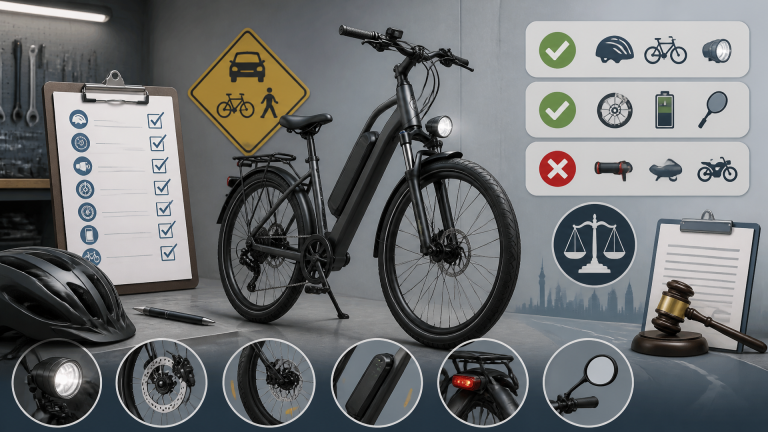
Practical Checklist Before You Ride
- [ ] Confirm your bike has a class label affixed
- [ ] Verify your motor is 750W or less
- [ ] Confirm your top speed matches your class (20 mph for Class 1/2, 28 mph for Class 3)
- [ ] Check local sidewalk rules for your city
- [ ] Check trail rules for the specific trail you plan to ride
- [ ] Wear a helmet (required for Class 3, recommended for all)
- [ ] If you’re under 16, wear a helmet regardless of class
- [ ] If your bike has a throttle, verify it cuts out at 20 mph
The confirmation test: After you’ve checked everything, do a short test ride in your neighborhood. Accelerate to full assist speed and confirm the motor cuts out at the expected limit. If it doesn’t—or if the bike feels like it’s still pulling past the cutoff—don’t ride it on public roads until you’ve had the system checked.
Common Mistakes to Avoid
Assuming “it’s just a bike” everywhere. Local ordinances can restrict where you ride, even if state law is permissive. The city you’re visiting may have different rules than your hometown.
Modifying your bike without understanding the legal consequences. Removing the speed limiter on a Class 2 bike makes it a moped. That means registration, insurance, and a license—none of which you have.
Riding a Class 3 on a trail that only allows Class 1. Trail managers post class restrictions at trailheads. Ignoring them can result in a citation and, in some cases, a ban from the trail system.
Assuming beach access is universal. No Florida beach allows e-bikes on the sand. Beachfront paths are a separate question and vary by city.
Riding on sidewalks in tourist districts. The highest enforcement areas are where pedestrians are dense. If you’re near a beach, boardwalk, or festival, assume sidewalk riding is restricted.
The Decision Rule That Matters
If your bike has pedals, a motor under 750W, and can’t exceed 20 mph on throttle alone, you’re riding a legal e-bike in Florida. You don’t need registration, insurance, or a license. Ride on roads, in bike lanes, and on trails that allow bicycles—but check local rules for sidewalks and specific trails.
If any of those three conditions fail, you’re riding a moped. That changes everything: registration, insurance, license, and helmet requirements all apply. The fix is simple: keep your bike within the legal definition, and you keep the legal treatment of a bicycle.
The one decision criterion that changes your entire legal standing: throttle speed. A bike with a throttle that tops out at 20 mph is a bicycle. The same bike with the limiter removed is a moped. Before you buy a used e-bike, test the throttle speed first—if it exceeds 20 mph, walk away unless you’re prepared to register and insure it.
Florida’s e-bike laws are permissive by design. The state wants e-bikes treated like bicycles, and it has built the legal framework to make that work. The responsibility is on you to keep your bike within the definition—and to check local rules where you ride.