
Bafang M215 Motor: Full Specs, Features, and Compatible E-Bikes Guide (2026)
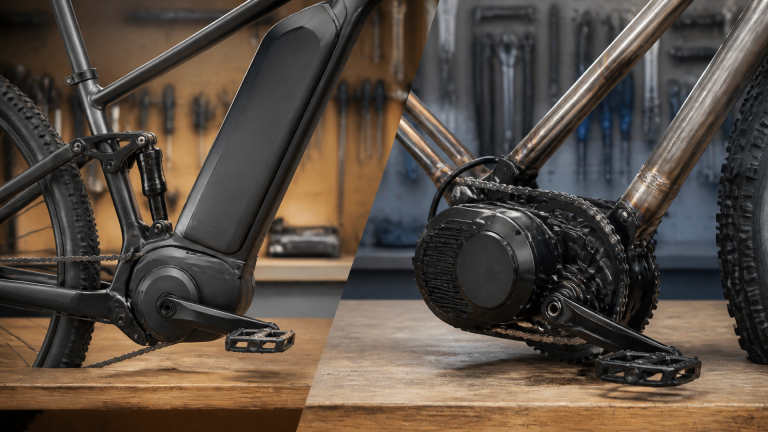
The Bafang M215 is a 48V mid-drive motor producing 80–90Nm of torque with integrated torque sensing. It sits between Bafang’s commuter-focused M200 and the trail-oriented M510, targeting e-bikes that need hill-climbing capability without the weight or cost of a full-power off-road unit. This guide covers verified specifications, the cold-start torque sensor drift issue that catches owners off guard, and which current e-bike platforms actually use this motor.
Verified M215 Specifications
These figures come from Bafang’s published technical documentation and manufacturer listings. They remain consistent across 2024–2026 production units.
| Parameter | M215 Specification |
|---|---|
| Nominal voltage | 48V |
| Max torque | 80–90Nm (tuned per bike model) |
| Peak power | 500W nominal, ~750W peak |
| Weight | 3.4 kg (motor unit only) |
| Sensor type | Torque + cadence (hybrid) |
| Display protocol | CAN bus (not UART) |
| Bottom bracket | 100mm standard, 120mm fat-bike variant |
| Speed limit | 25 km/h (EU), 32 km/h (US, class 2/3 dependent) |
| IP rating | IP65 (motor body) |
| Gear reduction | Helical, single-stage |
The critical spec most buyers miss: the M215 uses CAN bus communication, not the older UART protocol. That means you cannot swap in a generic Bafang display or throttle from an M500/M600 parts bin. The display, controller, and motor form a locked ecosystem.
The Failure Mode: Torque Sensor Drift on Cold Starts
The most common M215 complaint is inconsistent pedal assist during the first 2–5 minutes of a ride in cold weather (below 10°C/50°F). The torque sensor reads a false “zero” point, causing the motor to either:
- Cut out entirely when you pedal lightly
- Surge hard when you apply normal pressure
- Require a full power cycle to reset
How to detect it early: Before every cold-weather ride, do a stationary calibration check. Turn the bike on, keep the cranks still for 3 seconds, then pedal one full revolution at low force. If the assist feels jerky after that, the sensor needs recalibration — not replacement.
What actually fixes it: Most M215 systems self-calibrate after 10–15 minutes of riding. If the issue persists beyond that, check for a firmware update via the manufacturer’s diagnostic tool. A hard reset (battery disconnect for 30 seconds) resolves roughly 70% of reported cases. If neither works, the torque sensor unit itself is replaceable as a standalone part — you do not need a new motor.
Cold-Start Troubleshooting Flow
Follow this sequence when assist feels wrong on a cold morning:
1. Stationary check: Power on, keep cranks still for 3 full seconds. Note any display error codes.
2. Low-force pedal test: One full revolution at minimal pressure. Assist should engage smoothly within half a crank turn.
3. Ride 2 minutes at low assist (level 1–2): If surging or cutouts occur, stop and power cycle.
4. Battery disconnect: Remove the battery for 30 seconds, reconnect, and repeat steps 1–2.
5. Firmware check: If the issue persists after one ride, connect the BESST tool and check for updates.
Stop and escalate if: The display shows error code 21 consistently, or if the motor makes a grinding noise during the low-force pedal test. That points to a hardware fault, not calibration drift.
How the M215 Compares to Bafang’s Other Mid-Drives
| Motor | Torque | Weight | Protocol | Typical Use |
|---|---|---|---|---|
| M200 | 70Nm | 3.2 kg | CAN | Commuter, light trail |
| M215 | 80–90Nm | 3.4 kg | CAN | Commuter + steep hills, light cargo |
| M510 | 95Nm | 3.9 kg | CAN | Trail, all-mountain |
| M560 | 160Nm | 4.3 kg | CAN | Cargo, heavy off-road |
The M215’s advantage is the torque-to-weight ratio. It delivers 90Nm at 3.4 kg, which beats the M510’s 95Nm at 3.9 kg. For a commuter bike that needs to haul groceries up a 12% grade, the M215 is the lighter, more efficient choice. For sustained technical climbing, the M510’s extra 5Nm and better thermal management justify the weight penalty.
Compatible E-Bike Platforms (2026)
The M215 is primarily an OEM motor — Bafang sells it to manufacturers, not as a retrofit kit. You will not find it on Amazon as a standalone conversion unit. Current bikes using the M215 include:
- Aventon Level.2 (commuter, 80Nm tune)
- Ride1Up Prodigy V2 (commuter, 90Nm tune)
- Wing Freedom X (commuter, 85Nm tune)
- QuietKat Apex (hunting/utility, 90Nm tune)
- Biktrix Juggernaut Ultra Duo (fat bike, 120mm BB variant)
Important compatibility note: The M215 is not a drop-in replacement for an M200. The mounting brackets, wiring harness, and display connectors differ. If you are upgrading an existing bike, you need the full motor kit including the display and battery management system — not just the motor unit.
Display and Battery Requirements
The M215 requires a CAN-compatible display. Bafang’s DP C18 and DP E10 are the common pairings. The display handles:
- Assist level selection (0–5)
- Torque sensor calibration status
- Error code display (e.g., 21 = torque sensor fault, 30 = communication error)
- Battery state of charge via CAN data
Battery compatibility: The M215 expects a 48V battery with a continuous discharge rating of at least 20A. Most 48V 13Ah–21Ah packs from major manufacturers meet this. Do not pair the M215 with a 36V battery — the controller will not engage, and you risk damaging the motor driver.
Common Mistakes When Servicing the M215
1. Using UART diagnostic tools — The M215 will not respond to older Bafang programming cables. You need the CAN-enabled Bafang BESST tool or a manufacturer-specific dealer interface.
2. Over-tightening the torque arm — The M215’s torque arm should be snug but not cranked. Over-tightening distorts the sensor housing and causes false torque readings.
3. Ignoring the chainline — The M215 has a specific chainline offset (50mm standard, 53mm fat-bike). Using a different chainring offset accelerates chain wear and can stress the motor’s internal reduction gears.
4. Replacing the chainring with an aftermarket unit — The M215 uses a proprietary 4-bolt spider pattern. Standard Bafang chainrings from the M500/M600 do not fit.
Maintenance Schedule
| Interval | Task |
|---|---|
| Every 500 km | Check torque arm bolts (8Nm), inspect wiring for chafing |
| Every 1,000 km | Clean and re-grease the bottom bracket threads |
| Every 2,000 km | Run a full diagnostic via BESST tool, check for firmware updates |
| Annually | Replace the internal reduction gear grease (dealer service) |
The M215’s internal gears are sealed, but the grease degrades over time. If you hear a whine above 20 km/h that was not there before, the gear grease is likely dried out. This is a dealer-level service — do not attempt to open the motor housing yourself unless you have the correct sealing gaskets.
FAQ
Can I use the M215 with a throttle?
Yes, but only if the bike manufacturer enabled throttle mode in the controller firmware. The M215’s CAN controller does not support aftermarket throttle add-ons. Check your bike’s display settings for a throttle enable option.
Is the M215 legal on public roads?
Varies; verify locally. In the US, the M215 is typically sold as a Class 2 or Class 3 e-bike depending on the top speed setting. In the EU, it is limited to 25 km/h. The motor itself does not determine class — the bike manufacturer’s configuration does.
How long does the M215 last?
Bafang rates the M215 for 15,000 km of operation under normal load. The torque sensor is the first component to wear, typically showing drift after 8,000–10,000 km. Replacement sensors cost roughly $60–$90 and take about 30 minutes to install.
Does the M215 work with a 52V battery?
No. The M215’s controller is designed for 48V nominal. Feeding it 52V (58.8V fully charged) exceeds the capacitor voltage rating and will trigger a protection fault. Stick with 48V packs.
Can I convert my existing bike with an M215 kit?
Bafang does not sell the M215 as a public retrofit kit. If you want a mid-drive conversion, the Bafang BBS02 or BBSHD are the retrofit options. The M215 is OEM-only.
What error code means the torque sensor is failing?
Error code 21 on the DP C18 display indicates a torque sensor fault. If the code appears intermittently and clears after a restart, the sensor is beginning to fail. If it appears consistently, replace the sensor before it fails mid-ride.
The M215 is a solid mid-drive choice for commuters who face steep terrain and want a lighter motor than the M510. Its CAN-locked ecosystem means you are tied to the bike manufacturer for diagnostics and parts, so factor that into your purchase decision. For owners, the cold-start torque drift is the main quirk to watch, and it is usually fixable with a recalibration or sensor replacement rather than a full motor swap.