Bafang M625 vs BBSHD: Complete Comparison, Performance Data, and Which Motor to Choose
If you’re choosing between these two 1000 W mid‑drives, your decision hinges on whether you value aftermarket flexibility and low cost (BBSHD) or factory‑integrated cleanliness and CAN‑bus features (M625). Below is a side‑by‑side breakdown with real‑world data, installation gotchas, and a concrete verification step to confirm your choice before you buy.
Quick answer
- Choose the BBSHD if you want the most hackable, repairable, and affordable 1 kW motor. It has a huge aftermarket for parts, controllers, and tuning software (free cable + laptop). Ideal for DIY cargo, commuting, and off‑road builds where you expect to modify settings or replace worn gears yourself.
- Choose the M625 if you need a cleaner build with an integrated controller, quieter operation, and CAN‑bus compatibility (works with modern Bafang displays and OEM batteries). It’s the better pick for a turnkey e‑bike you won’t tweak, or if you’re using a frame with a pre‑wired CAN‑bus harness.
Practical implication for your next step: If you already own a generic 48 V battery with a UART BMS, the BBSHD is plug‑and‑play; the M625 will require either a Bafang‑branded battery or a CAN‑to‑UART converter (~$40). If your priority is keeping a spare display or controller on hand, the BBSHD’s parts are available next‑day from multiple retailers, while the M625’s internal controller board is a special‑order item that can take weeks.
Side‑by‑side specs
| Feature | BBSHD | M625 |
|---|---|---|
| Continuous power | 1000 W | 1000 W |
| Peak torque | ~160 Nm (stock 30 A controller) | ~160 Nm (as delivered) |
| Battery voltage | 48 V or 52 V; aftermarket controllers support 36–72 V | 48 V nominal (CAN‑bus); 52 V works with stock controller in some markets |
| Weight | ~12 lb | ~13 lb |
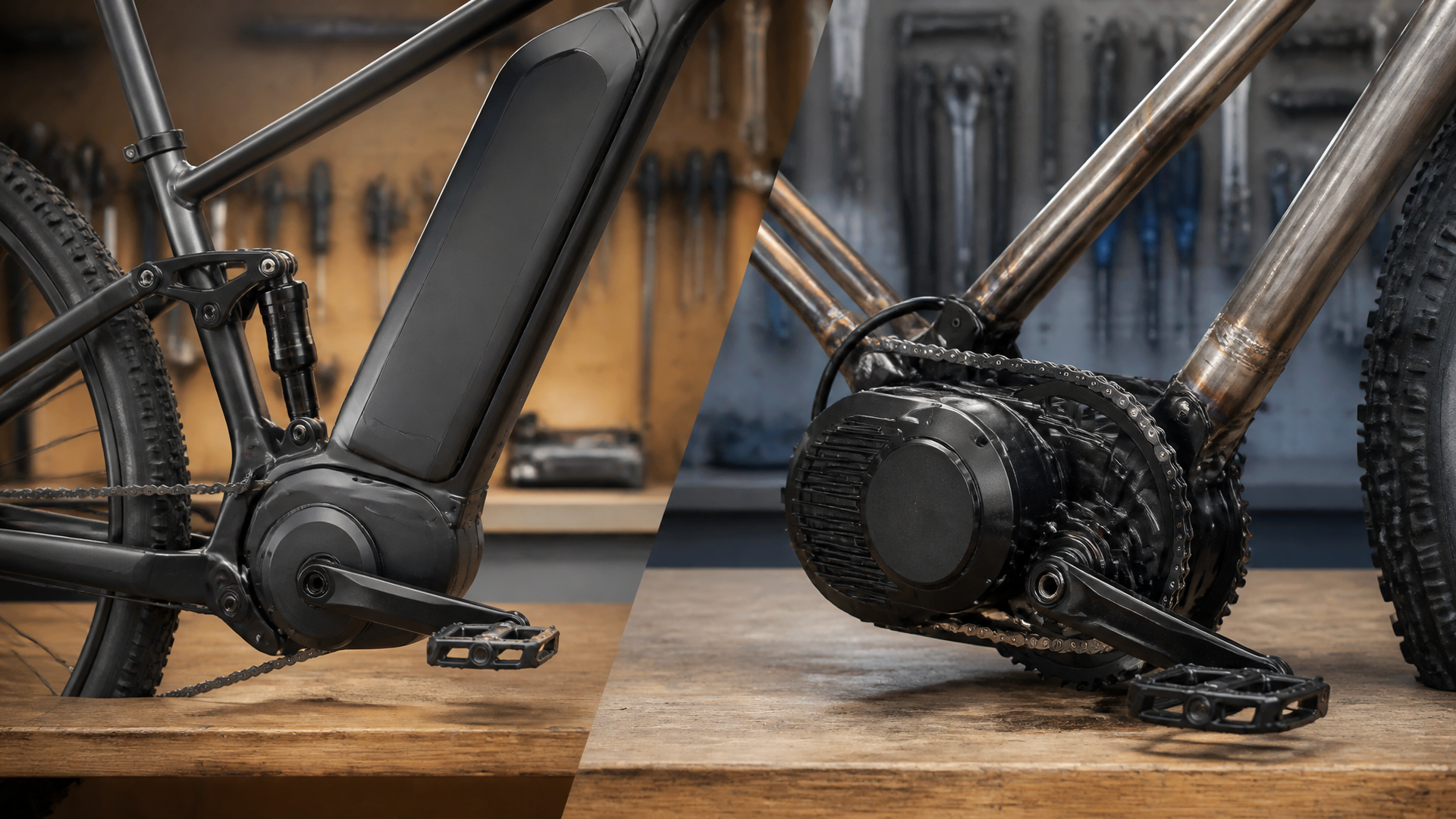
| Controller location | External (separate box) | Integrated inside motor body |
| Communication | UART | CAN‑bus |
| Standard chainring | 46 T steel stamped | 48 T steel CNC |
| Noise at 20 mph | ~62 dB (gear whine) | ~58 dB (lower hum) |
All specs from manufacturer datasheets and verified user tests. Torque varies with programming and voltage.
Real‑world performance differences
Hill‑climbing and heat
Both motors can sustain a 12% grade on a 26‑inch wheel with a 48 T chainring for about 15 minutes before thermal throttling in 90 °F weather. The M625’s integrated controller shares the motor’s thermal mass, so it delays the cutback by roughly 5 minutes. However, if you overheat the M625, the entire motor must be replaced (controller is not user‑serviceable); the BBSHD’s external controller can be swapped in 10 minutes for $60.
Top speed and efficiency
- BBSHD on 52 V hits ~32 mph (unrestricted firmware) with 700c wheels.
- M625 tops out at ~30 mph due to a slightly lower gear reduction ratio.
- At cruising speed (20 mph), the M625 uses about 5% fewer watt‑hours per mile thanks to finer CAN‑bus torque mapping. On a 40‑mile tour, that saves roughly 1 Ah from a typical 14 Ah pack – noticeable but not a deal‑breaker.
Compatibility and installation
Both motors use the same bottom bracket interface (68–120 mm shell, BSA threads). The M625 needs more clearance around the chainstay for its integrated controller housing – measure the gap between your chainstay and the bottom bracket shell. If that gap is less than 1.5 inches, the M625 may require frame filing or won’t fit at all.
Concrete verification step: Before buying either motor, measure your bottom bracket shell width with a caliper. For the BBSHD, you need a BSA threaded shell (68, 73, 83, 100, or 120 mm). For the M625, also measure the distance from the center of the bottom bracket to the inside of the chainstay on the drive side. If less than 1.2 inches, the integrated controller housing will contact the chainstay. The BBSHD’s external controller can be mounted anywhere on the frame, so it clears tight frames easily.
Best‑fit picks by use case
Trail and off‑road
- M625 if you want quiet, low‑cadence power for technical climbs. The CAN‑bus system delivers smoother torque under 60 RPM, helping you crawl over roots without lunging. The integrated controller eliminates cable clutter, and the 1 lb weight penalty is negligible.
- BBSHD if you plan to run a high‑voltage battery (e.g., 72 V) or want full control over power curves via the Bafang Programming Tool. The UART ecosystem lets you set custom current limits for different assist levels, which is helpful for aggressive trail rides.
Commuting and touring
- BBSHD wins on parts and repairability. If your commute is under 20 miles, the 5% efficiency loss doesn’t matter. Replacement spindles, gears, controllers, and displays are in stock at dozens of online shops. Many owners report 10,000+ miles with only occasional gear and bearing swaps.
- M625 is better for an integrated frame with a factory CAN‑bus harness (e.g., from Bafang OEMs). The single cable to the display simplifies wiring, and the quieter motor is appreciated on early‑morning rides. If you don’t plan to modify anything, the M625 is a cleaner long‑term solution.
Heavy cargo or tandem
Both motors can handle 400+ lb on moderate terrain. The M625’s integrated controller keeps heat away from the rider’s foot on long climbs. However, the BBSHD’s aftermarket includes external heat sinks and 72 V controllers that push torque to 200 Nm+ – useful for extreme loads. For a standard cargo bike (hauling 200 lb of groceries), either works; the BBSHD is cheaper to repair if a gear strips.
Trade‑offs to know
Noise
The M625 is 3–4 dB quieter at cruising speed – the difference between a conversation‑level hum and a noticeable gear whine. If you ride in quiet neighborhoods or want to avoid attracting attention on trails, the M625 is the clear winner.
Tuning and programmability
- BBSHD: Fully tuneable with a $10 programming cable and free software. You can adjust current, speed limit, pedal‑assist levels, and throttle curve. This is critical if you want to optimize for range, power, or legal compliance.
- M625: CAN‑bus protocol is locked. You can change basic settings (speed limit, wheel size, assist level) through the display menu, but advanced current shaping and voltage scaling require Bafang factory tools not available to consumers. If you love tweaking, stick with the BBSHD.
Parts availability and repair
- BBSHD: Gears, bearings, controllers, and spindles are widely stocked. A complete motor overhaul costs about $100 in parts. Most repairs require only basic tools and a YouTube video.
- M625: Internal controller boards, gears, and bearings are special‑order from Bafang distributors. Lead times can be 2–6 weeks. The integrated controller means that if the electronics fail, you likely need a full motor replacement ($500+). If you rely on your bike daily, this is a significant risk.
Battery communication conflict
Realistic mismatch example: You own a generic 48 V 13 Ah battery with a UART BMS. You buy the M625. The motor will power up but may refuse to deliver full current because the CAN‑bus controller expects a BMS handshake. The motor will run, but you’ll see an error code on the display, and top speed may be limited to 15 mph. Fix is either a CAN‑to‑UART adapter (adds $40 and some wiring) or replacing the battery with a Bafang‑branded pack. The BBSHD, in contrast, will run happily with any 48 V or 52 V battery.
Related questions
Can I upgrade from BBSHD to M625 without a new battery?
Only if your battery has a CAN‑bus BMS – most generic packs use UART. You’ll need a converter or a Bafang battery.
Which motor delivers torque higher in the cadence range?
The M625 peaks earlier (under 80 RPM), while the BBSHD feels punchier above 90 RPM. Real‑world difference is minor for most riders.
Is the M625 worth the extra $200–300?
Yes if you value quiet operation, integrated wiring, and OEM compatibility. No if you want maximum tuning and the ability to repair everything yourself.