Texas E-Bike Laws: Classes, Helmet Rules, and Where You Can Ride (2026 Guide)
Texas treats e-bikes as bicycles under state law, not motor vehicles. That one classification drives nearly everything: no license, no registration, no insurance, and access to most places traditional bicycles can go. But the class system creates hard boundaries, and crossing them changes your bike’s legal status entirely.
Here’s what you need to know before you ride in Texas.
The Three E-Bike Classes Defined by Texas Law
Texas Transportation Code § 551.101 establishes three e-bike classes. Your class determines where you can ride, who can operate the bike, and what equipment it must have.
| Class | Motor Function | Top Speed | Speedometer Required? |
|---|---|---|---|
| Class 1 | Pedal-assist only; motor stops when you stop pedaling | 20 mph | No |
| Class 2 | Throttle or pedal-assist; motor can propel without pedaling | 20 mph | No |
| Class 3 | Pedal-assist only; motor stops when you stop pedaling | 28 mph | Yes |
The 750-watt cap applies to all three classes. Motor output cannot exceed 750 watts (1 horsepower) for any e-bike in Texas.
The speedometer requirement is not optional for Class 3. A Class 3 bike without a functioning speedometer does not comply with state law, even if the motor is correctly limited. If you buy a Class 3 bike used and the display is dead, you’re riding a non-compliant vehicle until you fix it.
The throttle trap: A bike with a throttle that can push it past 20 mph does not fit Class 2. A pedal-assist bike that works past 28 mph does not fit Class 3. In both cases, the bike falls outside the legal definition of an electric bicycle entirely.
What Makes an E-Bike Legal in Texas
The statutory definition requires all three of these:
1. Two or three wheels
2. Operable pedals — the bike must be capable of being pedaled
3. An electric motor of 750 watts or less — with speed limits matching the class definitions above
Fail any one of these, and your bike is legally a motor vehicle. That means it needs a license plate, title, registration, and insurance — and you cannot ride it on bike lanes, bike paths, or trails designated for bicycle use.
The derestriction problem: Aftermarket “unlimited” controllers and derestriction kits that remove the 20 mph or 28 mph cap instantly change your bike’s legal classification. It doesn’t matter how you normally ride it. The capability alone is what counts. If a police officer tests the bike and it exceeds the class limit, you’re operating an unregistered motor vehicle.
License, Registration, and Insurance: What Texas Requires
None of the three classes require a driver’s license, registration, or insurance in Texas.
This applies even to Class 3 bikes that reach 28 mph. The state classifies them as bicycles, so the usual vehicle requirements do not apply.
What this means in practice:
- You don’t need a driver’s license to operate an e-bike
- There is no title or registration process for e-bikes
- Your auto insurance does not cover e-bike accidents
The coverage gap: The lack of an insurance requirement doesn’t mean you have no liability exposure. If you cause an accident on an e-bike, you’re personally responsible for damages. A standard homeowners or renters policy often provides some personal liability coverage away from your property, but limits vary significantly. Some policies exclude e-bikes entirely. Call your insurer and ask specifically about e-bike liability coverage before you assume you’re protected.
Helmet Rules: Age and Class
Texas requires helmets for e-bike riders under 21 years old, across all three classes.
| Rider Age | Helmet Required? |
|---|---|
| Under 21 | Yes — all classes |
| 21 and over | No state requirement (Class 1, 2, or 3) |
The helmet must meet U.S. Consumer Product Safety Commission (CPSC) standards. A properly fitted bicycle helmet with a CPSC sticker satisfies the requirement.
The age rule is tied to the rider, not the bike. A 20-year-old on a Class 1 bike must wear a helmet. A 45-year-old on a Class 3 bike has no state helmet requirement. That said, a 28 mph crash without a helmet is a serious head-injury risk regardless of what the law says.
Local variations: Some Texas cities have helmet ordinances that apply to all cyclists, not just minors. Austin requires helmets for riders under 18 on all bicycles, including e-bikes. Check your municipal code before assuming the state rule is the only rule.
Where You Can Ride: Roads, Trails, and Sidewalks
Riding locations depend on your class and your local jurisdiction. Here’s the breakdown.
On Public Roads
All three classes may ride on roadways where bicycles are permitted. Texas law grants e-bike riders the same rights and duties as bicycle riders:
- You can use bike lanes where they exist
- You can ride on the road, generally in the right-hand lane
- You must obey traffic signals and signs
- You can use the full lane when it’s too narrow to share safely with a vehicle
Restriction: E-bikes are not allowed on limited-access highways (interstates and toll roads) where bicycles are explicitly prohibited. Texas law bans bicycles from controlled-access highways, and e-bikes follow the same rule.
On Bike Paths and Trails
This is where class matters most.
- Class 1 and Class 2: Allowed on bike paths and trails, unless a local ordinance or trail authority prohibits them
- Class 3: Prohibited on bike paths and trails unless a local ordinance or trail authority specifically allows them
The default rule for Class 3 is exclusion. This is the opposite of what most new owners assume. If you buy a Class 3 bike, you’re limited to roadways unless you find a trail that explicitly permits Class 3 use. That’s a significant constraint for anyone who wants mixed road-and-trail riding.
On Sidewalks
Texas state law does not explicitly address e-bikes on sidewalks. Local ordinances govern sidewalk riding, and the rules vary significantly:
- Some cities allow sidewalk riding outside business districts
- Some prohibit it entirely for adults
- Some treat e-bikes differently from traditional bicycles
Check your city’s code before you ride on a sidewalk. Riding where prohibited can result in a citation, and it’s also where conflicts with pedestrians are most likely. When in doubt, ride on the road.
Texas State Parks: The Class 1 Advantage
Texas Parks and Wildlife Department (TPWD) manages e-bike access at state parks, and the policy is not uniform across all parks.
General rule: E-bikes are allowed on roads open to motor vehicles and on trails designated for bicycle use, subject to the same rules as traditional bicycles.
Key distinctions:
- Class 1 e-bikes: Generally treated like traditional bicycles. Allowed on bike-accessible trails and park roads.
- Class 2 and Class 3 e-bikes: Restricted to roads open to motor vehicles and trails specifically designated for motorized use. Not allowed on standard bike trails.
The odd consequence: A Class 2 bike with a throttle is excluded from most park trails, while a Class 1 bike with the same motor power is allowed. The policy is based on the motor’s capability, not how you actually use it. If your primary riding is on state park trails, a Class 1 bike is the safer choice.
Verify locally: Individual parks may have additional restrictions or allowances. Check the specific park’s rules before you load up the bike rack.
Local Ordinances: Where State Law Ends and City Rules Begin
Texas state law sets a baseline, but cities and counties can impose their own restrictions. The Texas Transportation Code explicitly allows local authorities to regulate e-bike use on bike paths, trails, and sidewalks.
Common local variations:
- Sidewalk restrictions: Some cities prohibit e-bikes on sidewalks in business districts
- Trail restrictions: Some cities ban all e-bikes from specific multi-use trails, even Class 1
- Age requirements: Some cities require helmets for all riders, regardless of age
- Speed limits: Some trails impose speed limits below the class maximums
Examples of local rules:
- Austin: Requires helmets for riders under 18 on all bicycles and e-bikes. Some city trails restrict e-bike access.
- Dallas: Follows state law for road use but has specific trail designations that may exclude certain classes.
- Houston: Allows e-bikes on city trails but requires riders to follow posted speed limits.
Decision rule: Before you ride in an unfamiliar city, check two things: the municipal code for sidewalk rules and the parks department website for trail designations. Both are usually available online.
Penalties and Enforcement
Penalties for e-bike violations in Texas are generally the same as for bicycle violations — civil fines, not criminal offenses.
Typical violations and consequences:
- Riding where prohibited (e.g., Class 3 on a bike path): Fine, typically $25–$200 depending on the jurisdiction
- Helmet violation (under 21): Fine, usually under $100
- Operating a non-compliant e-bike (motor over 750W or speeds above class limits): More serious. The bike is treated as a motor vehicle, and riding it without registration, a license, and insurance can result in separate citations for each violation
The compounding problem: The penalty for riding an over-powered e-bike is not a simple fine. Because the bike is legally a motor vehicle, you can face separate citations for no license, no registration, and no insurance — each with its own fine. The total can run several hundred dollars, and the bike may be impounded.
How to Verify Your E-Bike Is Legal in Texas
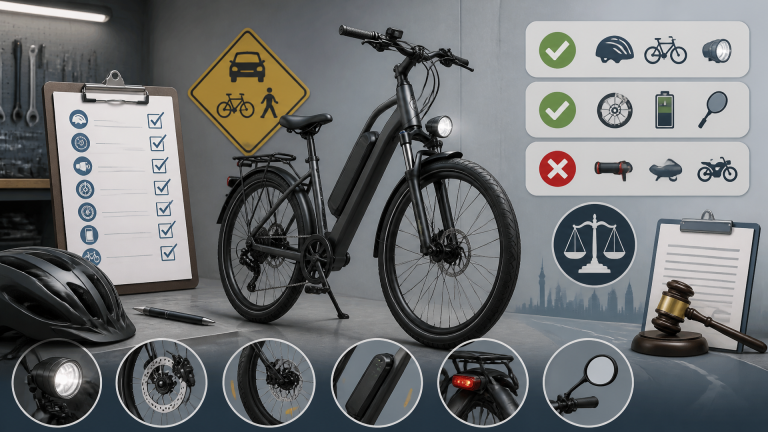
Use this checklist before you ride:
1. Check the motor wattage. Look for a label or stamp on the motor. It must be 750W or less.
2. Check the top speed. If it has a throttle, it must not exceed 20 mph on motor power alone. If it’s pedal-assist only, it must not exceed 28 mph.
3. Check the pedals. The bike must have operable pedals.
4. Check the class label. Many manufacturers print the class on the frame or in the manual. If there’s no label, determine the class based on motor and speed characteristics.
5. Check your local rules. Confirm sidewalk and trail rules for your city.
If your bike fails any of these checks, it is not an e-bike under Texas law. You have three options:
- Modify it to comply — replace the motor or controller with a compliant one
- Register it as a motor vehicle — requires title, insurance, and a license plate
- Limit riding to private property — where state vehicle laws don’t apply
A realistic scenario: You buy a used e-bike online that the seller claims is “Class 3.” You check the motor label — it’s stamped 1000W. That bike is not a Class 3 e-bike. It’s an unregistered motor vehicle. Riding it on public roads puts you at risk for multiple citations and impoundment. Your options: replace the motor with a 750W unit, register it as a moped or motorcycle (which requires title, insurance, and a license), or sell it and buy a compliant bike.
Buying an E-Bike in Texas: Match the Class to Your Riding
If you’re shopping for an e-bike and plan to ride it legally in Texas, the class designation is the first filter.
Choose Class 1 if:
- You want maximum access to trails and bike paths
- You plan to ride in state parks
- You prefer pedal-assist riding and don’t need a throttle
Choose Class 2 if:
- You want a throttle for starting from a stop or riding without pedaling
- You ride mostly on roads and city streets
- You accept that some trails will be off-limits
Choose Class 3 if:
- You want higher speeds for commuting on roads
- You don’t need trail access
- You’re comfortable riding in traffic at 28 mph
Verify the spec sheet, not the product title. Some sellers list bikes as “Class 3” when they actually exceed the 750W motor limit or have a throttle that pushes past 20 mph. A bike that doesn’t fit a class is not street-legal, regardless of what the listing claims. Check the motor label and the controller settings before you buy.
FAQ
Is a 750W ebike legal in Texas?
Yes, a 750W e-bike is legal in Texas, provided it also meets the class speed limits and has operable pedals. The 750W limit is the maximum motor power allowed for all three e-bike classes. A bike with a motor rated above 750W does not qualify as an e-bike and is treated as a motor vehicle.
Is a 50 mph e-bike street legal?
No. A 50 mph e-bike is not street-legal in Texas because it exceeds the maximum speed for all three e-bike classes. The fastest legal class (Class 3) is limited to 28 mph. A bike capable of 50 mph is legally a motor vehicle and requires a license, registration, title, and insurance to operate on public roads.
What e-bikes are illegal in Texas?
E-bikes are illegal in Texas if they exceed the statutory definition: a motor over 750W, no operable pedals, or speeds beyond the class limits. Bikes with derestricted controllers or aftermarket modifications that remove speed caps also fall outside the legal definition. These bikes cannot be ridden on public roads, bike lanes, or trails designated for bicycles.
Do I need a license to ride an ebike in Texas?
No. Texas does not require a driver’s license to operate a legal e-bike of any class. E-bikes are classified as bicycles under state law, not motor vehicles, so the licensing requirements that apply to cars and motorcycles do not apply. This is true even for Class 3 e-bikes that can reach 28 mph.
The practical takeaway: Texas e-bike law is permissive at the state level, but the class system creates real boundaries. Class 1 gives you the most access to trails and parks. Class 3 gives you speed but locks you out of most off-road infrastructure. And any bike that exceeds the 750W or speed limits is not an e-bike at all — it’s an unregistered motor vehicle. Match the class to where you actually plan to ride, and verify local rules before you rely on state law alone.