Bafang M500 vs M600: Full Specs, Torque Data, and Which Motor to Choose (2026)
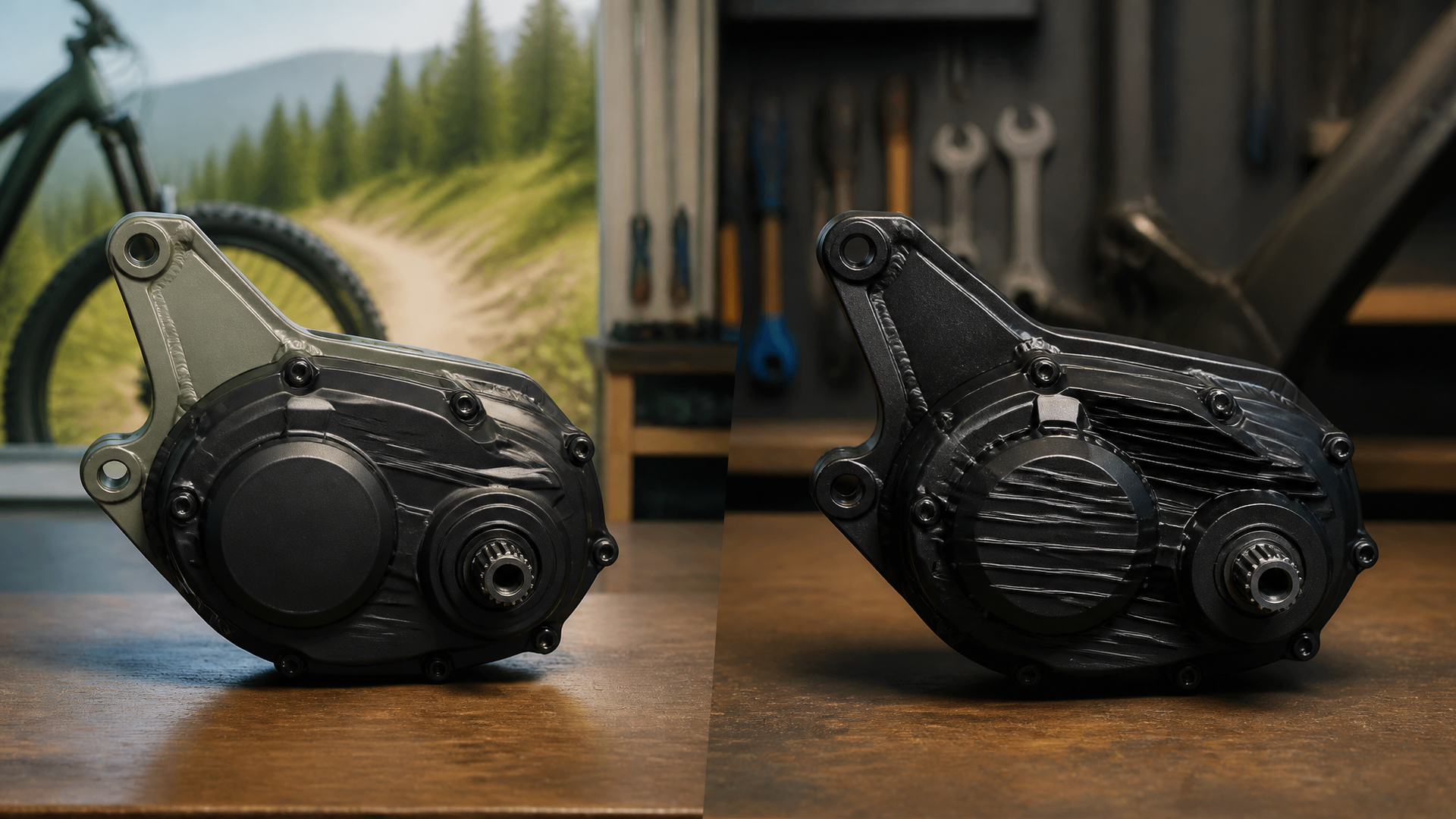
The Bafang M500 and M600 are two of the most common mid-drive motors in the e-bike market, but they serve different riders. The M600 delivers 120 Nm of peak torque—roughly 60% more than the M500’s 75 Nm—while the M500 runs lighter, quieter, and more efficiently per watt-hour. The right pick depends on three variables: terrain, battery capacity, and whether you’re building a bike or buying a complete one.
Here’s the spec data, what the torque figures actually feel like on the trail, and a decision framework that goes beyond the marketing numbers.
Spec Comparison: M500 vs M600
| Specification | Bafang M500 | Bafang M600 |
|---|---|---|
| Peak Torque | 75 Nm | 120 Nm |
| Nominal Power | 250W–500W variants | 500W (up to 1000W in some configs) |
| Weight | ~3.5 kg (7.7 lbs) | ~4.3 kg (9.5 lbs) |
| Voltage | 48V | 48V |
| Torque Sensor | Optional | Standard |
| Display Compatibility | DP C18, DP E18, EggRider | DP C18, DP E18, EggRider |
| Cooling | Passive (finned housing) | Active (internal fan on some versions) |
| Typical Use | Commuter, light trail, touring | Enduro, heavy trail, cargo |
| Motor-Only Price | ~$400–$600 | ~$600–$900 |
Specs vary by manufacturer, firmware version, and regional regulations. Verify local compliance before purchase.
Torque Data: What 75 Nm vs 120 Nm Actually Feels Like
Torque determines climbing ability and acceleration from a standstill. The gap between these two motors is substantial, and it shows up in specific riding situations.
M500 (75 Nm): Handles 15% grades without strain. On 20% grades, you’ll hear the motor working harder and need to drop to a low gear with meaningful pedal input. This is adequate for most commuters and recreational trail riders who don’t chase steep climbs.
M600 (120 Nm): Climbs 20% grades with authority and still pulls hard on 25% grades. This is the motor for cargo bikes, steep mountain trails, and riders who want maximum assist without spinning at high cadence.
The trade-off is energy consumption. The M600 draws more current under load, which generates more heat and drains batteries faster. Owner-reported data and independent testing suggest the M600 consumes roughly 10–15% more energy than the M500 on identical routes at the same speed.
The Decision Criterion That Changes Everything: Battery Capacity
Most comparisons stop at torque figures, but your battery size should drive this decision more than any other factor.
With a 48V 14Ah battery (672 Wh), the M500 delivers roughly 35–50 miles of range depending on assist level. The M600 on the same battery gives you 25–35 miles. If your rides regularly exceed 30 miles, the M600 will create range anxiety unless you carry a spare battery.
With a 48V 21Ah battery (1008 Wh) or larger, the M600’s higher consumption becomes manageable. The extra torque is worth the range hit because you have enough capacity to absorb it.
Rule of thumb: Under 750 Wh of battery capacity, choose the M500. Over 750 Wh, the M600 is the better pick for performance-oriented riders.
Weight and Handling Differences
The M500 weighs about 0.8 kg (1.8 lbs) less than the M600. On a bike, this difference affects how the front end feels and how easy the bike is to lift onto a rack or carry up stairs. The M500’s lighter weight makes it feel more responsive in tight maneuvers.
The M600’s extra mass sits low and central, which improves stability on descents. On aggressive trails, that weight feels planted rather than sluggish. If you ride mostly pavement or smooth gravel, you’ll notice the M500’s weight advantage more than the M600’s stability benefit.
Which Motor Should You Choose?
Choose the M500 if:
- You ride mostly pavement or light gravel
- You want maximum range per watt-hour
- You’re building a commuter or touring bike
- You prefer a quieter motor
- You’re working with a budget under $600 for the motor
Choose the M600 if:
- You ride steep, technical trails
- You carry cargo or ride a heavy bike
- You want the strongest possible climbing performance
- You have a battery capacity above 750 Wh
- You don’t mind extra weight and noise
Common Problems and Maintenance Considerations
Both motors are generally reliable, but they have known failure points that owners report across forums and review threads.
Bafang M500:
- Torque sensor failure can occur if the bottom bracket is over-tightened during installation. Use a torque wrench and follow the spec (typically 40–50 Nm).
- Some units develop a rattling noise from internal planetary gears after 1,000+ miles. This is cosmetic, not a failure.
Bafang M600:
- Heat buildup is the main concern. The M600 runs hot under sustained load, and some versions have an internal fan that can fail. On long, steep climbs, monitor motor temperature and let it cool down.
- The wiring harness connector can corrode if exposed to water. Apply dielectric grease and check the connection periodically.
Lifespan: Bafang mid-drives typically last 10,000–20,000 miles with proper maintenance. The M500 operates under less stress and often outlasts the M600. The M600’s higher torque wears drivetrain components faster—plan to replace the chainring and chain more frequently.
Installation and Compatibility Notes
If you’re building a bike, these motors are not interchangeable drop-in units.
1. Frame compatibility: The M500 and M600 use different mounting brackets. The M500 uses a standard ISIS bottom bracket, while the M600 uses a proprietary Bafang bracket. Check your frame’s bottom bracket shell width (68mm or 73mm) before buying.
2. Display and wiring: Both motors use the same display protocol, so the DP C18 or DP E18 display works with either. Third-party displays like the EggRider also work.
3. Battery connector: Both motors use the same 48V connector, but verify the pinout matches your battery. Some aftermarket batteries use different connectors.
4. Torque sensor calibration: The M600’s torque sensor requires calibration after installation. Bafang provides the procedure in the manual. The M500’s optional torque sensor also needs calibration.
How to Verify Fit Before You Buy
Before ordering either motor, measure your frame’s bottom bracket shell width with a caliper. Standard widths are 68mm and 73mm. The M500 fits both, but the M600’s proprietary bracket may not clear certain frames with integrated battery mounts or thick down tubes. Also confirm your frame’s chainstay clearance—the M600’s wider motor housing can interfere with rear suspension linkages on some full-suspension frames.
If you’re buying a complete bike rather than building one, check the manufacturer’s spec sheet for the motor mounting standard. Some brands use a modified M600 bracket that only fits their frames, which means you can’t swap motors later without frame modification.
Speed Limits and Legal Compliance
The speed limit for both motors depends on controller firmware and local regulations. In the US, Class 1 and Class 2 e-bikes are limited to 20 mph with motor assist; Class 3 is limited to 28 mph. In the EU, the limit is 25 km/h (15.5 mph) for pedal-assist.
Bafang sells both motors with different firmware configurations. Some aftermarket versions can be unlocked for higher speeds, but this may be illegal in your jurisdiction and voids the warranty. Verify local laws before modifying anything.
Real-World Performance: Cadence and Riding Style
The M600 feels strongest at low cadence. If you prefer to mash a 60–70 RPM cadence, the M600’s torque curve matches your style. If you like to spin at 90+ RPM, the M500 feels smoother and more natural.
This matters more than most spec sheets suggest. Riders who prefer high-cadence spinning often find the M600’s power delivery abrupt, while low-cadence riders feel the M500 lacks punch. Test ride both if you can—this is a feel decision, not just a numbers decision.
FAQ
Which Bafang motor is best?
The best Bafang motor depends on your use case. For commuting and general riding, the M500 offers the best balance of weight, efficiency, and reliability. For aggressive trail riding or cargo hauling, the M600’s 120 Nm of torque is the better choice. The M620 (also called the Ultra) is Bafang’s top-tier motor with 160 Nm, but it’s heavier and more expensive.
What is the speed limit of the Bafang M600 electric bike?
The speed limit depends on firmware and local regulations. In the US, the M600 is typically limited to 20 mph (32 km/h) for Class 2 compliance or 28 mph (45 km/h) for Class 3. In the EU, the limit is 25 km/h (15.5 mph). Some aftermarket firmware can remove the limit, but this is illegal in most jurisdictions.
What are the common problems with Bafang motors?
The most common issues are heat buildup on the M600 under sustained load, torque sensor failures on both motors (often caused by over-tightening the bottom bracket), and wiring connector corrosion from water exposure. Regular maintenance—checking connectors, cleaning the motor, and replacing drivetrain components—prevents most problems.
What is the lifespan of a Bafang mid-drive?
With proper maintenance, Bafang mid-drive motors typically last 10,000–20,000 miles. The M500 tends to outlast the M600 because it operates under less stress. Replacing the chain, cassette, and chainring regularly—especially on the M600—extends motor life by reducing drivetrain strain.
Making the Final Call
For most riders, the M500 is the smarter choice. It’s lighter, quieter, more efficient, and significantly cheaper. The 75 Nm of torque is plenty for commuting, fitness riding, and moderate trail use.
Choose the M600 only if you specifically need the extra torque—steep climbs, heavy loads, or aggressive off-road riding. The 120 Nm figure delivers in practice, but you’ll pay for it in weight, noise, and battery consumption.
If you’re still unsure, look at your typical ride. If you can count the steep climbs on one hand, the M500 is enough. If steep climbs are the reason you ride, get the M600. And if your battery is under 750 Wh, the M500 is the only choice that makes sense.