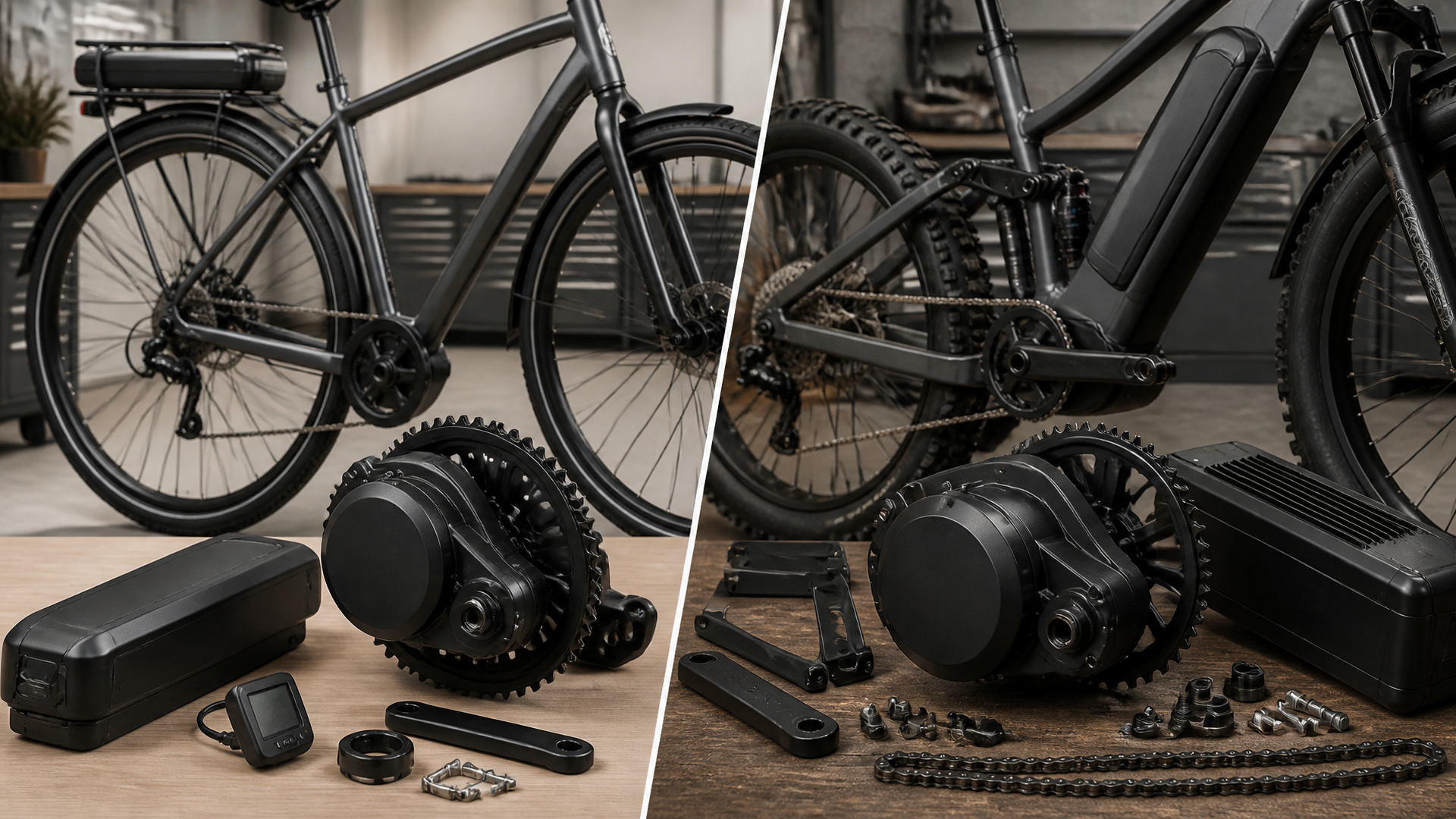
Bafang BBSHD vs BBS02: Complete Comparison, Specs, and Which Motor to Choose
Choose the BBS02 if you ride mostly flat to rolling terrain, want a lighter kit, and stay under 250–275 lb total weight. Choose the BBSHD if you regularly tackle steep hills, carry heavy cargo, or need bulletproof reliability for daily commuting. The BBSHD costs more and weighs more, but its extra torque and thermal capacity make it the better long-term choice for demanding use.
Side-by-Side Specs
| Feature | BBS02 | BBSHD |
|---|---|---|
| Nominal power (common rating) | 750 W continuous | 1000 W continuous |
| Peak power | ≈1500 W | ≈2500 W |
| Peak torque | ≈120 Nm | ≈160 Nm |
| Weight (motor only) | ≈6.5 lb (2.9 kg) | ≈9 lb (4.1 kg) |
| Controller | Internal, 25 A max | Internal, 30 A max (some versions 35 A) |
| Gear reduction | Nylon planetary gear (metal gear available as upgrade) | Steel planetary gear (stock) |
| Heat dissipation | Smaller housing, less thermal mass | Larger housing, better heat shedding |
| Legal class (USA) | Typically Class 1/2/3 depending on firmware; verify locally | Usually Class 2/3; verify local limits |
| Typical kit price difference | BBS02 ≈ $450–600 | BBSHD ≈ $650–850 |
All specs are manufacturer‑typical. Actual performance depends on battery voltage, controller settings, and riding conditions.
How to Choose Based on Your Riding Profile
Rider and Cargo Weight
- Under 200 lb total (rider + bike + gear): BBS02 is sufficient for most hills.
- 200–275 lb: BBS02 works but runs hotter on long climbs. BBSHD runs cooler and has more reserve torque.
- Over 275 lb or heavy cargo (e.g., trailer, groceries): BBSHD’s steel gears and higher torque prevent premature wear. The nylon gear in the BBS02 can strip under sustained high load.
Terrain Profile
- Flat to moderate hills (≤8% grade): BBS02 climbs fine; the 120 Nm is ample.
- Steep hills (≥10% grade) or long mountain passes: BBSHD’s 160 Nm and better thermal management keep motor temps lower. The BBS02 will throttle earlier due to heat buildup.
Battery and Range Needs
- BBS02 is more efficient at lower power (≈15–18 Wh/mi typical). For a given battery size, you get slightly more range.
- BBSHD draws more current, especially at full throttle; expect ≈18–22 Wh/mi. Plan for a battery with ≥48 V and ≥20 Ah if you want 40+ mile range under heavy assist.
- Both motors work with 48 V or 52 V batteries. The BBSHD benefits more from 52 V because it can use higher phase current.
Cost and Upgrade Path
- Budget‑conscious build: BBS02 + a 48V 17Ah battery is a proven, affordable combo.
- Future‑proof or cargo build: BBSHD + 52V 20Ah battery costs more upfront but avoids a motor swap later if your needs grow.
- Programming: Both can be tuned via the Bafang configuration cable. The BBSHD has wider headroom for current limits without overheating.
Noise and Pedal Feel
- BBS02 is slightly quieter at low cadence due to the nylon gear (some users report a whine under load).
- BBSHD has a lower‑pitched gear noise; the steel gears make it a bit louder but more durable.
- Both exhibit some cogging drag when pedaling without assist. The BBSHD’s freewheel is marginally lower resistance.
What This Means for Your Build Decision
If you’re still on the fence, the practical takeaway is this: spend the extra $200–300 on the BBSHD if you ever see a 10% grade or carry more than 20 lb of cargo. The BBSHD’s extra cost acts as an insurance policy against overheating and gear failure. For flat‑ish commutes under 10 miles and rider weight under 200 lb, the BBS02 is a proven, budget‑friendly choice that will last years.
Real-World Performance Differences
Heat Management
The BBSHD’s larger stator and aluminum housing dissipate heat much faster. On a continuous 10‑mile climb at 15 mph, the BBS02 typically enters thermal throttle (power cut) after 3–4 miles; the BBSHD can finish the same climb without throttling. If you live in a hot climate or ride in stop‑and‑go traffic, the BBSHD’s heat capacity is a deciding factor. One owner reported that after upgrading from a BBS02 to a BBSHD, his commute time dropped by 12 minutes because he no longer had to stop and let the motor cool on the uphill section.
Gear Reliability
The BBS02’s nylon planetary gear is designed for ≤750 W continuous. Running a BBS02 at max power (1500 W peak) repeatedly can cause gear wear or stripping. The BBSHD’s steel gear set handles sustained high torque without issues. Users who upgrade the BBS02 with a metal gear still face limits on the motor’s thermal tolerance; the motor itself can overheat even with a metal gear if you push it on a long, steep climb.
Controller Capabilities
Both motors use internal sine‑wave controllers. The BBSHD’s controller can deliver higher phase current, which translates to better low‑speed torque from a stop. The BBS02’s controller is more limited; you can program it, but you cannot exceed 25 A battery current without risking controller damage. A common mistake is setting the BBS02’s current limit too high, which leads to controller failure within weeks.
Legal and Enforcement
- BBS02 at 750 W nominal typically fits into Class 1 (no throttle) or Class 2 (throttle ≤20 mph) depending on firmware.
- BBSHD at 1000 W nominal often exceeds Class 2 limits in some states. It may be classified as a moped or require registration. Verify your local e‑bike laws (e.g., California, New York, European EN 15194 if overseas). Using a programming tool to limit speed/power can help remain legal, but enforcement varies.
Battery Connector Compatibility
Both motors use Anderson‑type connectors for battery leads. The BBSHD draws higher current; ensure your battery’s BMS can handle 35 A continuous (or at least 30 A). A cheap BMS on a budget battery can trip under the BBSHD’s peak draw, cutting power mid‑climb. To verify, check the BMS rating printed on the battery case or ask the seller before purchasing.
How to Verify Fit on Your Bike
Before you order, measure your bottom bracket shell width with a caliper. Both motors fit 68–73 mm shells; the BBSHD also fits 100 mm shells (common on fat bikes). If your shell is narrower than 68 mm or wider than 100 mm, neither motor will mount without an adapter. Also check the chainstay clearance: the BBSHD’s larger housing can interfere on some frames with tight triangle geometry.
Common Mistakes to Avoid
- Choosing the BBS02 for a heavy cargo bike. The nylon gear will fail under sustained 1500 W loads on steep hills.
- Under‑specifying the battery for the BBSHD. A 48V 13 Ah battery will give only 20–25 miles of range.
- Forgetting to program the controller. Stock settings often have high current limits that cause heat issues; a quick programming session improves efficiency.
- Ignoring chainline. Both motors have offset chainrings; you may need to adjust the front derailleur or use a narrow‑wide chainring to avoid chain drops.
FAQ
Can I upgrade from a BBS02 to a BBSHD without changing my battery?
Yes, but your battery must support higher continuous discharge (≥30 A). If your current battery has a 25 A BMS, you will limit the BBSHD’s performance. Check the BMS rating before swapping.
Which motor is more reliable for daily commuting?
The BBSHD, because its steel gears and larger thermal mass withstand repeated full‑power starts and long climbs. The BBS02 is reliable within its power limits, but those limits are lower.
Does the BBSHD weigh too much for a lightweight mountain bike?
At +2.5 lb over the BBS02, the weight difference is noticeable but not deal‑breaking for most riders. The extra weight is low on the frame, so handling is still good. For competitive XC riding, the BBS02 is lighter.
Which motor is easier to install?
Both are similar: you need a bottom bracket removal tool, a torque arm, and a display. The BBSHD requires a slightly larger bottom bracket hole (68–73 mm or 100 mm). Measure your BB shell width before ordering.
Can I use the same display and throttle for both?
Yes, Bafang displays (like the C961, DPC‑18) are compatible with both motors. Throttles are also interchangeable.
Final Take
Your choice comes down to workload. The BBS02 is a capable, lightweight motor for recreational riders and light commuting. The BBSHD is a workhorse built for steep terrain, heavy loads, and daily abuse. If you plan to keep the bike for years and push it hard, the BBSHD pays back its higher cost in durability. If you want a simple, efficient conversion for flat‑ish routes and moderate weight, the BBS02 is a proven, budget‑friendly option.
Always verify local e‑bike class and power limits before purchasing. Battery and motor specifications are typical; actual performance depends on your full system build.
Explore This Topic
- Back to Commercial
- Back to Quality Fix Batch
Related guides in this cluster: