Understanding e-bike regulations and how cops prove your e-bike is illegal
Cops prove your e-bike is illegal by checking the manufacturer label, running the serial number, testing your speed, and inspecting modifications. If your bike doesn’t match its declared class or exceeds legal limits, you’ll get a citation or impound. The methods are straightforward and repeatable, so knowing them is your best defense. This article covers exactly what officers look for, how they build a case, and what you can do to stay legal.
BLOCKQUOTE_0
Know Your Class: The First Thing Cops Check
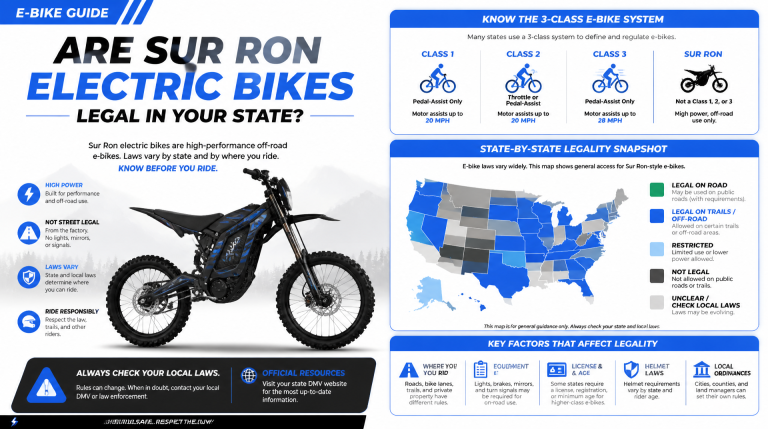
Most US states follow the three‑class system. Your bike’s class determines where you can ride and what officers will compare it against.
- Class 1: Pedal‑assist only, no throttle, motor stops at 20 mph.
- Class 2: Throttle allowed, motor stops at 20 mph.
- Class 3: Pedal‑assist only, motor stops at 28 mph (some states allow a throttle up to 20 mph).
If your bike’s frame label is missing, painted over, or says a different class than what the bike actually does, the officer will default to the highest speed/power the bike can achieve. That often means your bike gets reclassified as a moped or motor vehicle.
Practical implication for owners: When shopping, choose a bike with a permanent, legible compliance sticker on the frame. If you already own one, check that the label matches your bike’s real behavior. A bike sold as “Class 2” that can actually reach 28 mph is a ticket waiting to happen – even if you never use the throttle.
How Police Verify Your E‑Bike’s Class
Officers don’t guess. They use three main checks.
1. Manufacturer Label and Serial Number
The compliance sticker lists wattage, class, and top assisted speed. Police run the serial number through manufacturer databases or state records. For example, a California Highway Patrol officer can access the manufacturer’s online portal for brands like Rad Power Bikes or Super73 to verify original specs. If the label is missing or doesn’t match the serial, the bike is presumed illegal until proven otherwise.
Concrete verification step you can do: Find your bike’s serial number (usually stamped on the bottom bracket or near the rear dropout). Look up the model online or call the manufacturer to confirm the original specs. Compare that to the sticker on your frame. If the sticker says “750W” but the manufacturer database shows a 1000W motor, you have a mismatch that officers will catch.
2. Speed Test
An officer can pace you, use radar, or ask you to pedal hard while they hold a radar gun. If your bike exceeds the legal limit for its class – even by 1 or 2 mph – that’s direct evidence of tampering or an overpowered motor.
- A Class 2 bike doing 25 mph? The motor should have cut off at 20.
- A Class 3 bike doing 30 mph? The limiter is gone.
- In states like New York, any e‑bike exceeding 20 mph on a bike path is automatically a motor vehicle violation, regardless of its class label.
3. Visual and Mechanical Inspection
Cops look for:
- Throttle on a Class 1 bike – they’ll twist it while the bike is stationary.
- Oversized hub motor – a 1000W motor is visibly larger than a 750W one; a common tell is the motor casing diameter exceeding 5 inches.
- Third‑party display or controller – many aftermarket screens let you change wheel size or voltage to remove speed limits. A display that shows “P” settings or a voltage menu is a red flag.
- Missing speed sensor – if the magnet on the wheel is gone, the controller often defaults to unlimited speed. Officers may also check for a loose or cut sensor wire.
When the Rules Change: States, Trails, and Modifications
Not all enforcement is the same. The biggest applicability difference is by state. For example:
- California treats Class 3 bikes as street‑legal but bans them from many bike paths; officers often set up radar checkpoints on popular multi‑use trails.
- New York considers any e‑bike that exceeds 20 mph a motor vehicle, regardless of class label – even a stock Class 3 on city streets can be cited.
- Texas follows the federal system closely but allows local ordinances to override. Austin, for instance, bans e‑bikes on certain hike‑and‑bike trails entirely.
Also, if you’ve modified your bike – even with legal parts – the officer may still cite you based on the original frame label. A 750W motor with a 52V battery might be fine in theory, but if the label says 500W, you’ll be writing a check.
Realistic mismatch/trade‑off: You can downgrade your bike to make it legal (e.g., swap a 1000W controller for a 750W one, or remove a throttle). But police may not accept a post‑modification claim without documentation. If the frame label says “Class 2” and you’ve removed the throttle, they may still consider it a Class 2 because the label hasn’t changed. Keep the original parts and receipts, and consider having the bike re‑inspected by a dealer to get a new compliance sticker.
If You’re Stopped: A Practical Plan
Stay calm and be ready to provide the bike’s class and your ID (if required). Do not argue about the label. Instead, ask which specific check they found non‑compliant. If it’s a missing label, you can offer to provide the original purchase receipt or a manufacturer spec sheet later. If it’s a speed violation, you may need to prove the bike is stock by showing the speed sensor is intact and the controller is factory‑sealed.
Never ride with obvious illegal modifications – throttle on a Class 1, removed speed limiter, or a battery pack labeled “72V.” That gives probable cause for impound. In many jurisdictions, a modified e‑bike can be impounded on the spot and held until you present a dealer inspection proving it meets class limits; you may also owe a storage fee.
Frequently Asked Questions
Can a cop tell if my e‑bike is over 750W just by looking at it?
Sometimes, especially if the hub motor is oversized or the battery is labeled with a higher voltage. Officers also check the serial number to see the original motor wattage. A 1000W motor is roughly 20% larger in diameter than a 750W motor, which is noticeable to an experienced officer.
Do I need a license or registration for an e‑bike?
In most states, no – as long as the bike meets the class limits (750W, speed cap, functional pedals). Bikes that exceed those limits are typically treated as mopeds and require a license, registration, and insurance. Some states, like New Jersey, require a driver’s license for Class 3 e‑bikes used on roadways.
What happens if my e‑bike is found illegal?
Penalties vary. You may receive a fine (typically $50‑$250 for a first offense), and the bike may be impounded until you prove compliance (e.g., by showing a stock label or a receipt for a legal downgrade). Repeat offenses can lead to higher fines or the bike being destroyed. In some states, a citation can also count as a moving violation, affecting your driving record.
Knowing how officers prove your e‑bike is illegal lets you ride with confidence. Check your bike’s label, verify its class, and keep any documentation that shows it’s stock. If you’re unsure about local rules, contact your state’s vehicle code office or your local police traffic division – they can tell you exactly what they check.