E-Bike Laws by State: Complete 50-State Comparison (2026)
The three-class system (Class 1, 2, and 3) is the legal backbone for electric bikes in 47 states as of 2026, but it does not guarantee uniformity. The differences that matter most—age minimums, helmet requirements, throttle rules, and where you can ride—vary significantly by state and even by city or trail system. This guide covers every state’s ebike laws in detail, explains the federal framework, and gives you the specific tools to stay legal.
If you modify your bike beyond legal limits or attempt to ride a non-compliant machine on public roads, the consequences can include fines, impoundment, and even criminal charges. If you have altered the motor wattage, removed the speed limiter, or modified the throttle, stop riding the bike on public roads and consult a qualified attorney or your state DMV to determine whether your bike still qualifies as an ebike.
The Three-Class System: Your Starting Point
The three-class system, enacted by the Consumer Product Safety Commission (CPSC) in 2002, is the federal baseline for ebike classification. Here is how the classes break down:
- Class 1: Pedal-assist only; the motor stops providing assistance at 20 mph.
- Class 2: Throttle-assisted (or pedal-assist), capped at 20 mph.
- Class 3: Pedal-assist only; motor stops at 28 mph. No throttle allowed that can propel the bike above 20 mph.
As of 2026, only three states—Hawaii, Mississippi, and Vermont—have not fully adopted the three-class system. Hawaii classifies ebikes as mopeds if they exceed 750 W or 20 mph. Mississippi has no statewide classification at all, leaving rules to local jurisdictions. Vermont was in the process of aligning with the three-class framework as of late 2025 but had not finalized legislation; currently, local ordinances govern.
The CPSC also requires a permanent label on the bike that states its class, top speed, and motor wattage (maximum 750 W). That label is your legal proof. If it fades, peels, or is removed, you risk the bike being treated as an unregistered motor vehicle during a traffic stop. Verification step: before you ride for the first time, take a clear photo of the label and note the serial number. Ride with that image on your phone or a printed copy. If the label is unreadable, contact the manufacturer for a replacement sticker. If you cannot obtain replacement labeling, do not ride the bike on public roads until you resolve it—that label is your only evidence that the bike meets the legal definition.
Key Legal Variables That Vary by State
Even in the 47 three-class states, six variables create the patchwork you need to navigate.
1. Minimum age. Most states set 16 as the minimum age for Class 3. A handful, like California, require 16 for all classes. Others (e.g., New York) allow any age on Class 1 and 2 but require 16 for Class 3. Delaware and Arizona have no statewide age minimum for Class 1 and 2, meaning a 12-year-old can ride legally—but local ordinances may impose restrictions. Michigan sets the minimum at 14 for all classes, which is lower than most states for Class 3.
2. Helmet laws. Helmet requirements are typically tied to age. California requires helmets for all riders under 18 on any class. New York requires helmets for all Class 3 riders regardless of age, and for Class 1 and 2 riders under 14. Massachusetts requires helmets for Class 3 riders under 17. Texas has no statewide helmet law for ebikes, but some city ordinances (e.g., Austin) require helmets on city trails. In practice, enforcement of helmet laws is low, but in a collision, not wearing a helmet can weaken your liability claim.
3. Where you can ride. Sidewalk riding is illegal for ebikes in most urban areas (New York City, Chicago, Los Angeles, San Francisco). Multi-use paths are generally open to Class 1 and 2 but closed to Class 3 in states like New York, Massachusetts, Illinois, and Oregon. Bike lanes are usually fair game for all classes, but some states (e.g., Massachusetts, New York) require Class 3 riders to use road lanes or bike lanes only—never multi-use trails. Federal land managers impose their own rules (covered later).
4. Throttle restrictions. Oregon bans throttles on Class 1 and Class 3—only Class 2 may have a throttle. California permits throttles on Class 2 limited to 20 mph; Class 3 is throttle-prohibited entirely. New York treats any ebike capable of throttle operation above 20 mph as a moped, which requires a license and insurance. Oklahoma allows throttles on all classes but caps them at 20 mph. If you buy a bike that ships with a throttle on a Class 1 or Class 3 model, you must disable or remove it if riding in Oregon or California.
5. Speed limits. The federal 20 mph/28 mph caps apply on roads, but local speed limits on trails can be lower. Oregon imposes a 15 mph speed limit on all multi-use paths for any ebike. Colorado state parks enforce a 15 mph speed on paved trails. In Denver, the Cherry Creek Trail bans ebikes entirely during peak hours (7–9 AM and 4–6 PM weekdays). If you ride a Class 3 at 25 mph on a path where the limit is 15 mph, you can be cited for speeding, even though your bike is legal on roads.
6. Registration, insurance, and license. In all 50 states, ebikes that meet the three-class criteria (750 W max, speed caps, label) are not registered, insured, or licensed as motor vehicles. That advantage is real—but it disappears entirely if your bike is modified. If your motor exceeds 750 W or your bike can go faster than 28 mph, you are no longer riding an ebike. You are operating a motor vehicle, which may require a driver’s license, registration, and insurance.
A 1000 W motor on a bike that looks like an ebike is still a moped or motorcycle in the eyes of the law. If you have modified the motor or firmware to exceed legal limits, do not ride on public roads until you have consulted the state DMV or a traffic attorney. The fine for operating an unregistered motor vehicle in New York can exceed $500, and your bike may be impounded.
State-by-State Breakdown
The tables below cover every state, organized by region. Following each table, states with unusual or often misunderstood laws receive deeper treatment.
Northeast
| State | Class Adoption | Min Age (Class 3) | Helmet Required | Sidewalk/Trail Notes |
|---|---|---|---|---|
| Connecticut | Three-class | 16 | Under 18 (all classes) | No sidewalk; Class 3 banned from multi-use paths |
| Maine | Three-class | 16 | Under 16 (all classes) | Sidewalk allowed unless local ban; Class 3 roads only |
| Massachusetts | Three-class | 16 (Class 3); 14 (Class 1 & 2) | Under 17 (Class 3) | Class 3 banned from bike paths and multi-use trails |
| New Hampshire | Three-class | 16 | None statewide | Sidewalk allowed except where posted; Class 1 & 2 on trails; Class 3 roads only |
| New Jersey | Three-class | 15 | Under 17 (all classes) | No sidewalk; Class 3 banned from bike paths |
| New York | Three-class | 16 (Class 3); none (Class 1 & 2) | All ages on Class 3; under 14 on Class 1 & 2 | No sidewalk; Class 3 banned from multi-use paths and greenways |
| Pennsylvania | Three-class | 16 (Class 3); 12 (Class 1 & 2) | Under 18 (all classes) | No sidewalk; Class 3 roads and bike lanes only |
| Rhode Island | Three-class | 16 | Under 16 (all classes) | No sidewalk; Class 1 & 2 on trails; Class 3 roads only |
| Vermont | Not fully adopted (pending) | 16 (de facto) | Under 18 (all classes) | Trails open to Class 1 & 2; Class 3 restricted to roads |
Notable – New York: New York is one of the strictest and most actively enforced states for ebike laws. Since the 2020 legalization, the NYPD has issued thousands of summonses—primarily for Class 3 riders on the Hudson River Greenway and in Central Park. The legal trap many riders fall into: on paper, Class 3 is allowed on roads and bike lanes in New York City, but many of the city’s most popular bike lanes (e.g., the Hudson River Greenway) are classified as multi-use paths and therefore closed to Class 3. If you ride a Class 3 in NYC, your legal route options are extremely limited.
Additionally, any ebike with a throttle that can operate above 20 mph is treated as a moped—meaning you need a license and insurance. The NYPD has been known to use radar guns specifically targeting ebike speeds. If you are stopped and your bike exceeds 20 mph on a Class 2, you may be cited for operating an unregistered moped. Verification step: before riding in NYC, check the city’s official map of designated bike lanes that explicitly allow Class 3. Print that map or save it offline.
Notable – Massachusetts: The 2022 update aligned Massachusetts with the three-class system, but the state kept the old ban on Class 3 from “bicycle paths” and “multi-use trails.” The law defines these broadly—even paved rail-trails are off-limits for Class 3. Also, riders under 14 are not allowed to ride Class 1 or 2 on public roads; they can only ride on bike paths. This creates a strange scenario where a 13-year-old with a Class 1 may legally ride on a bike path but not on a residential street to get to that path.
Municipalities in the Boston area (Cambridge, Somerville) have additional restrictions on sidewalk riding and throttle use. If you ride a Class 2 with a throttle in Cambridge, you must keep your speed at or below 10 mph on sidewalks—and that only if the sidewalk is not posted otherwise.
South
| State | Class Adoption | Min Age (Class 3) | Helmet Required | Sidewalk/Trail Notes |
|---|---|---|---|---|
| Alabama | Three-class | 16 | None statewide | No sidewalk; trails open to Class 1 & 2 |
| Arkansas | Three-class | 16 | Under 17 (Class 3) | No sidewalk; Class 1 & 2 on trails; Class 3 roads only |
| Delaware | Three-class | None statewide | None statewide | Sidewalk allowed unless local ban |
| Florida | Three-class | 16 | Under 16 (all classes) | No sidewalk; Class 1 & 2 on trails; Class 3 roads and bike lanes only |
| Georgia | Three-class | 16 | None statewide | No sidewalk; trails open to all classes |
| Kentucky | Three-class | 16 | Under 18 (Class 3) | No sidewalk; trails open to Class 1 & 2 |
| Louisiana | Three-class | 16 | None statewide | No statewide sidewalk ban; trails open to all classes |
| Maryland | Three-class | 16 | Under 16 (all classes) | No sidewalk; Class 1 & 2 on trails; Class 3 roads only |
| Mississippi | No state classification | N/A | N/A | Local rules vary; ebikes often treated as bicycles if <750W and <20mph |
| North Carolina | Three-class | 16 | Under 16 (all classes) | No sidewalk; Class 1 & 2 on trails; Class 3 roads only |
| Oklahoma | Three-class | 16 | None statewide | No sidewalk; trails open to all classes |
| South Carolina | Three-class | 16 | None statewide | No sidewalk; trails open to all classes |
| Tennessee | Three-class | 16 | Under 16 (all classes) | No sidewalk; Class 1 & 2 on trails; Class 3 roads only |
| Texas | Three-class | 16 | None statewide | No sidewalk (except where local ordinance permits); Class 1 & 2 on trails; Class 3 roads only |
| Virginia | Three-class | 16 | Under 16 (all classes) | No sidewalk; Class 1 & 2 on trails; Class 3 roads only |
| West Virginia | Three-class | 16 | Under 16 (all classes) | No sidewalk; trails open to all classes |
Notable – Texas: Texas state law is relatively permissive—no helmet requirement, no statewide sidewalk ban—but local municipalities can and do override it. Austin’s Ann and Roy Butler Hike-and-Bike Trail bans all ebikes, period. Dallas allows Class 1 and 2 on trails but bans Class 3. Houston has no trail restrictions but enforces a 15 mph speed limit on all bikes in city parks. The critical gap: many riders assume that because Texas has no statewide helmet law, they never need one. In a crash, the evidence is clear—your risk of traumatic brain injury goes up by 50% without a helmet. That is not a legal requirement, but it is a practical one.
Notable – Florida: Florida is the most dangerous state for cyclists, with 6% of the nation’s bike traffic but 20% of the fatal bike crashes (NHTSA 2023 data). Ebike riders face the same risks. The law does not require insurance or a license, but if you are in a collision and your bike is found to exceed 750 W (e.g., a 1000 W motor), you can be charged with driving an unregistered motor vehicle. The “under 16” helmet rule applies to all classes, but enforcement is sporadic.
Class 3 ebikes are banned from the Florida Keys Overseas Heritage Trail, a popular route for tourists. If you are caught riding a Class 3 there, the fine can be up to $150. Verification step: before riding any trail in Florida, check the trail’s official website for the “ebike policy” statement. Many Florida state parks have a simple sign at the entrance that says “Bicycles Only” – that means no ebike allowed unless explicitly marked.
Midwest
| State | Class Adoption | Min Age (Class 3) | Helmet Required | Sidewalk/Trail Notes |
|---|---|---|---|---|
| Illinois | Three-class | 16 (Class 3); 12 (Class 1 & 2) | Under 18 (all classes) | No sidewalk; Class 3 banned from bike paths and multi-use trails |
| Indiana | Three-class | 16 | Under 16 (Class 3) | No sidewalk; Class 1 & 2 on trails; Class 3 roads only |
| Iowa | Three-class | 16 | None statewide | No sidewalk; trails open to all classes |
| Kansas | Three-class | 16 | None statewide | No sidewalk; trails open to all classes |
| Michigan | Three-class | 14 | Under 14 (all classes) | No sidewalk; Class 1 & 2 on trails; Class 3 roads only |
| Minnesota | Three-class | 16 | Under 18 (all classes) | No sidewalk; Class 1 & 2 on trails; Class 3 roads only |
| Missouri | Three-class | 16 | Under 17 (Class 3) | No sidewalk; trails open to all classes |
| Nebraska | Three-class | 16 | None statewide | No sidewalk; trails open to all classes |
| North Dakota | Three-class | 16 | None statewide | No sidewalk; trails open to all classes |
| Ohio | Three-class | 16 | Under 16 (Class 3) | No sidewalk; Class 1 & 2 on trails; Class 3 roads only |
| South Dakota | Three-class | 16 | None statewide | No sidewalk; trails open to all classes |
| Wisconsin | Three-class | 16 | Under 16 (all classes) | No sidewalk; Class 1 & 2 on trails; Class 3 roads only |
Notable – Illinois: Illinois has some of the strictest infrastructure limits in the Midwest. The Chicago Park District bans all ebikes from the Lakefront Trail, regardless of class—that means a Class 1 with pedal assist only cannot ride the 18-mile Lakefront Trail. This is a massive loss for commuters who could otherwise use that trail to get from Hyde Park to downtown. Suburban park districts (e.g., Cook County Forest Preserves) generally allow Class 1 and 2 on paved paths but prohibit Class 3 entirely.
The state also requires riders to be at least 12 to ride Class 1 or 2 on roads (16 for Class 3), which catches many parents who let their 10-year-old ride a Class 1 to school. If you live in the Chicago area, your safest legal option is Class 1 on city streets and bike lanes—avoid trails.
Notable – Michigan: Michigan’s minimum age of 14 for all classes is notably lower than most states. This means a 14-year-old can ride a Class 3 legally—but only on roads and bike lanes, not on multi-use trails. Michigan also permits sidewalk riding on Class 1 and 2 unless a local ordinance forbids it. In Detroit, the Riverwalk bans all ebikes, but the Dequindre Cut greenway allows Class 1 and 2. The state’s law explicitly excludes “electric skateboards and similar devices,” so a stand-up scooter with an ebike motor does not qualify as a bicycle—you would need a license.
West
| State | Class Adoption | Min Age (Class 3) | Helmet Required | Sidewalk/Trail Notes |
|---|---|---|---|---|
| Alaska | Three-class | 16 | Under 16 (all classes) | No sidewalk; trails open to all classes |
| Arizona | Three-class | None statewide | Under 18 (all classes) | No sidewalk; Class 1 & 2 on trails; Class 3 roads only |
| California | Three-class | 16 (all classes) | Under 18 (all classes) | No sidewalk (except where local ordinance allows); Class 1 & 2 on trails; Class 3 roads only |
| Colorado | Three-class | 16 | Under 14 (all classes) | No sidewalk; Class 1 & 2 on trails; Class 3 roads only; state parks limit speed to 15mph on paved trails |
| Hawaii | Moped classification | 15 (electric assist bicycle) | Under 16 (all) | No statewide sidewalk ban; trails limited |
| Idaho | Three-class | 16 | Under 16 (Class 3) | No sidewalk; trails open to all classes |
| Montana | Three-class | 16 | Under 16 (all classes) | No sidewalk; trails open to all classes |
| Nevada | Three-class | 16 | Under 18 (all classes) | No sidewalk; Class 1 & 2 on trails; Class 3 roads only |
| New Mexico | Three-class | 16 | Under 16 (all classes) | No sidewalk; trails open to all classes |
| Oregon | Three-class | 16 | Under 16 (all classes) | No sidewalk; Class 1 & 2 on trails; Class 3 roads only; 15mph limit on multi-use paths |
| Utah | Three-class | 16 | Under 17 (all classes) | No sidewalk; Class 1 & 2 on trails; Class 3 roads only |
| Washington | Three-class | 16 | Under 16 (all classes) | No sidewalk; Class 1 & 2 on trails; Class 3 roads only; statewide ban on ebikes from non-motorized trails |
| Wyoming | Three-class | 16 | None statewide | No sidewalk; trails open to all classes |
Notable – California: California was the first state to adopt the three-class system (2015) and has the most detailed, rider-unfriendly laws. All ebike riders must be at least 16 for any class. Helmets are required for riders under 18 for all classes. Class 3 ebikes cannot have a throttle that works above 20 mph—if your bike has a throttle that propels without pedaling, you must remove or disable it before riding. Sidewalk riding is illegal in most incorporated cities, but some suburbs (e.g., Santa Monica, Culver City) allow it with specific speed limits (10 mph).
The California Vehicle Code requires all ebike dealers to post a sign listing rider duties, but that sign rarely appears outside of bike shops near the counter. If you are stopped in California and cannot produce proof of your bike’s class (manufacturer label), the officer may impound the bike pending verification. The label is your only defense.
Notable – Colorado: Colorado’s state parks (Cherry Creek, Chatfield, Boulder County) impose a 15 mph speed limit on all bicycles on paved trails. This is a common speed trap for Class 3 riders who assume the federal 28 mph limit applies everywhere. In Denver, the Cherry Creek Trail bans ebikes during peak hours. In mountain towns like Breckenridge and Aspen, local ordinances restrict ebike access on singletrack trails even for Class 1. The reasoning: land managers say the motorized nature of ebikes increases trail wear and user conflict. If you plan to ride in Colorado, assume that any unpaved trail is off-limits unless you see a sign that specifically says “ebikes allowed.”
Notable – Oregon: Oregon’s multi-use path speed limit of 15 mph applies to all ebikes. This means a Class 3 rider on the Springwater Corridor (a popular 21-mile path) is speeding if they go above 15 mph. Enforcement is rare but not unheard of—Portland police have issued tickets to riders going 25 mph on the path. Additionally, Oregon bans throttles on Class 1 and Class 3. Only Class 2 may have a throttle. If you buy a bike that ships with a throttle on a Class 1 or 3, you must physically remove the throttle to comply. The state has no grace period for newly purchased bikes.
Trail Access: Federal vs State Land
State laws cover roads and local trails, but federal lands have their own rules, and they often conflict.
- National Park Service (NPS): As of 2026, ebikes are treated as bicycles on all NPS-managed trails where bicycles are allowed. This includes paved roads and bike paths in parks like Yellowstone, Grand Canyon, Great Smoky Mountains, and Yosemite. However, each park superintendent can restrict ebike access on unpaved or backcountry trails. In practice, Grand Canyon National Park bans ebikes from the South Kaibab Trail and Bright Angel Trail (both unpaved) but allows them on the paved Rim Trail. Yosemite allows ebikes on all paved roads and paths but forbids them on hiking trails. Always check the individual park’s “eBike Policy” page before your trip—a quick search will turn up a PDF.
- Bureau of Land Management (BLM): BLM lands generally allow ebikes where bicycles are allowed, with the same class limitations as the state in which the land sits. Most BLM areas permit Class 1 and 2 on non-motorized trails, but Class 3 may be banned in wilderness study areas. The BLM’s 2024 rule requires that ebikes on BLM trails must be “street legal” under state law. This creates a problem in Oregon and California, where Class 3 on some BLM trails may be treated as a motor vehicle violation.
- U.S. Forest Service (USFS): National forests follow state law for roads and plowed trails. On unpaved trails, the USFS has designated many as “non-motorized,” which means ebikes are prohibited unless specifically authorized. The current policy (2024) allows ebikes only on trails designated as “motorized.” That means the vast majority of mountain bike trails in national forests (e.g., Tahoe National Forest, Pisgah National Forest) are off-limits to ebikes. A few forests have created “ebike-allowed” segments (e.g., the Colorado Trail has a few miles open to Class 1), but they are rare. If you ride an ebike on a non-motorized USFS trail, you can be cited for trespassing and face a fine up to $250.
- State Parks and Local Trails: Every state park system has its own rules. A common pattern: Class 1 and 2 are allowed on paved trails, Class 3 is banned from all unpaved trails. But exceptions exist. In Vermont state parks, Class 1 ebikes are allowed on all multi-use trails, while Class 2 and 3 are not. In Florida state parks, ebikes are only allowed on roads and paved bicycle paths—not on hiking or equestrian trails. In Texas state parks, ebikes are treated as bicycles, meaning they can ride on any trail that allows bicycles (which is most paved trails). Verification step: before you ride in any state park, search “[Park Name] ebike policy 2026” and look for the official PDF. If you cannot find a PDF, call the park office. Do not rely on trailhead signs, which may be outdated.
Enforcement and What Happens If You’re Stopped
Police enforcement of ebike laws varies wildly. In cities with heavy bike traffic (New York, San Francisco, Portland, Chicago), officers regularly stop Class 3 riders for speeding or sidewalk riding. In smaller towns, you may be ignored unless you break a traffic law (running a stop sign, riding without lights at night). However, a single enforcement encounter can be expensive.
What to expect if you are stopped:
- The officer will ask about your bike’s class. Have your manufacturer label visible. If you removed it or it is unreadable, the officer may assume the bike is a moped. You can show the photo of the label on your phone as backup.
- Speed violations are common. If your bike is capable of exceeding 28 mph (or 20 mph in some jurisdictions), you can be cited for operating an unregistered motor vehicle. The fine in New York can exceed $500. In California, a Class 3 rider going 30 mph on a residential street can be charged with reckless driving under Vehicle Code 23103.
- Helmet tickets are low priority, but in California, if you are under 18 and not wearing one, the fine is $25. In New York, a Class 3 rider without a helmet can be fined $50.
- Sidewalk riding is a civil penalty in most cities, ranging from $50 to $250. In Los Angeles, the fine is $197 for first offense, $295 for second. In Portland, the fine is $104.
- If you are in a collision, the legal outcome often depends on whether you were lawfully operating your ebike. If your bike is modified (e.g., 1000 W motor), you may be found at fault, even if you had the right of way. Your homeowner’s or renter’s insurance may not cover you if your bike is noncompliant. If you have modified your bike beyond legal limits, do not ride it on public roads. Contact a traffic attorney or your state DMV to determine how to make the bike compliant—or sell it as a private property off-road bike only.
Bottom Line: How to Ride Legally in 2026
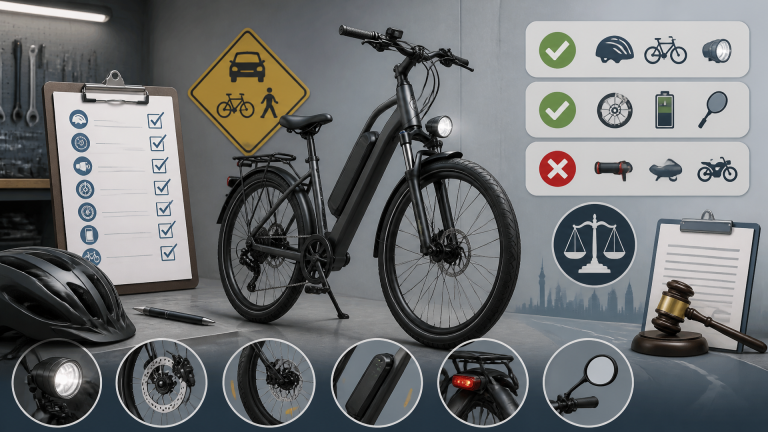
The three-class system provides a starting point, but state and local laws are the final authority. Here is your actionable checklist:
1. Check your state’s vehicle code. Search “[state] ebike law 2026” and find the specific section that defines classes, age, helmet, and riding infrastructure. Save the relevant code section on your phone.
2. Look up local ordinances. City and county rules can ban ebikes from trails that state law allows. Google “[your city] ebike ordinance” and check the municipal code.
3. Inspect your bike’s compliance. Ensure the manufacturer label is intact and legible. If it is not, contact the manufacturer for a replacement. Verification step: take a photo of the label and store it on your phone. Also measure your bike’s top speed on a flat road with a GPS speed app to confirm it stays within the class limits. If it exceeds, you have a modified bike and should stop riding on public roads.
4. Wear a helmet. Even if your state does not require it, a helmet is your best protection against serious injury. In a crash, the difference between a concussion and a skull fracture is often a few millimeters of EPS foam. There is no excuse not to wear one.
5. Ride predictably. Obey traffic lights, use hand signals, and yield to pedestrians on multi-use paths. That is the fastest way to avoid an encounter with law enforcement—and to keep ebike access positive in your community.
6. Know when to stop. If you modify the motor, remove the speed limiter, or install a throttle that works above 20 mph on a Class 3, you are no longer riding a legal ebike. Stop riding on public roads and consult an attorney or your state DMV. The fines and legal consequences are not worth the speed boost.
The patchwork of ebike laws in the United States is not going away. But by knowing the rules where you live and where you plan to ride, you can enjoy the speed and convenience of your ebike without legal headaches. When in doubt, print out the relevant statute and keep it with your bike’s manual. That paperwork could save you a ticket—and a long conversation with a police officer.