Understanding the Legality of Stealth Bomber E-Bikes
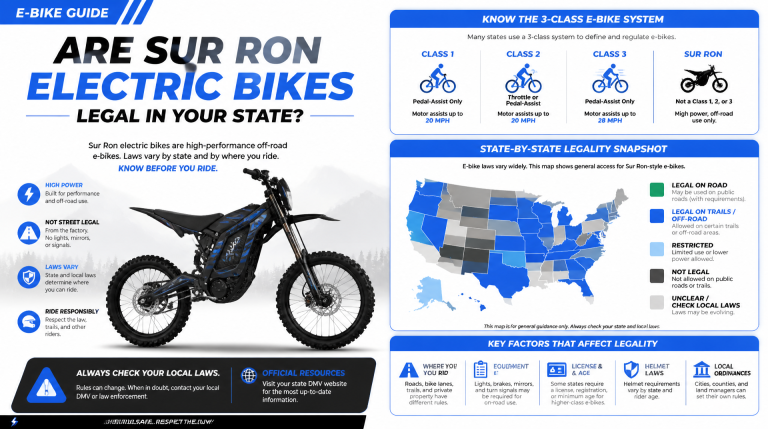
Stealth Bomber–style e-bikes are high‑power electric bikes that often exceed the legal limits for standard e‑bikes in the United States. Most stock models produce more than 750 watts and can exceed 30 mph, which means they fall outside the federal definition of a low‑speed electric bicycle. Whether you can legally ride one on public roads depends entirely on your state’s classification system and whether you register it as a moped or motorcycle.
What Makes a Stealth Bomber E‑Bike Different?
Stealth Bomber e‑bikes are built for performance, not low‑speed commuting. Typical specs include:
- Motor power from 1,000 to 5,000+ watts (federal e‑bike limit is 750W)
- Top speeds of 30–50 mph (federal e‑bike limit is 20 mph for throttle or pedal‑assist)
- Full‑suspension frames, fat tires, and styling that mimics an off‑road motorcycle
- Some models have functional pedals; others are effectively mopeds with token pedals
Because of these specs, they can’t legally be sold or ridden as ordinary e‑bikes under federal guidelines. Instead, they are typically classified as motor vehicles, mopeds, or off‑road only vehicles depending on state law.
Federal Classification: The 3‑Class System vs. Motor Vehicle Rules
The U.S. Consumer Product Safety Commission (CPSC) defines a low‑speed electric bicycle as a two‑ or three‑wheeled vehicle with operable pedals, a motor of 750 watts or less, and a top speed of 20 mph on paved surfaces. This definition covers Class 1 (pedal‑assist only, 20 mph), Class 2 (throttle, 20 mph), and some Class 3 (pedal‑assist, 28 mph) bikes.
A Stealth Bomber that exceeds any of those specs is not a low‑speed electric bicycle under federal law. That means it doesn’t get the consumer‑safety exemptions e‑bikes enjoy. Instead, it may be treated as a motor vehicle that must meet National Highway Traffic Safety Administration (NHTSA) safety standards, including:
- DOT‑approved headlights, taillights, turn signals, and brake lights
- Mirrors, horn, and reflectors
- Federal Motor Vehicle Safety Standards (FMVSS) for brakes, tires, and stability
- A Vehicle Identification Number (VIN)
Most Stealth Bomber kits and pre‑built bikes are not FMVSS‑compliant, which means they cannot be legally registered as motorcycles in practice without substantial modification.
State‑Level Laws Vary Widely
Each state decides how to classify a vehicle that falls between an e‑bike and a motorcycle. There is no single national standard.
Applicability Boundary: When the Answer Changes
The legality of your specific Stealth Bomber depends on the exact model, motor power, top speed, and whether the bike has a factory VIN. A 1,000W model with a 30 mph limiter may be registerable as a moped in some states, while a 5,000W model with no VIN may be impossible to legalize anywhere. The same bike that is street‑legal in Florida after adding a governor could be impounded in New York without any modifications because New York has no moped category for bikes over 750W. Always check your state’s motor vehicle code for the exact power and speed thresholds—not just the e‑bike class definitions.
States That Treat Them as Mopeds
Some states classify any two‑wheeled vehicle with a motor up to a certain displacement or power as a moped (e.g., 50cc equivalent or 1,000–2,000W). In these states you may be able to legally ride a Stealth Bomber if you:
- Register it as a moped
- Have a valid driver’s license (often a standard one is enough)
- Carry moped insurance
- Install a speed governor to keep it under the moped speed limit (usually 30 mph)
Example: In Florida, a scooter or “moped” with a motor less than 50cc (or equivalent electric power) and a top speed of 30 mph can be ridden with a regular license and registration. A Stealth Bomber set to 30 mph could qualify, but many local police still cite them for being unregistered motor vehicles.
States That Require Motorcycle Status
Other states have no moped category or set the kW limit very low. In these states, any vehicle exceeding the e‑bike power/speed limits must be titled and insured as a motorcycle, which is nearly impossible with a stock Stealth Bomber because of the FMVSS gap.
Example: In California, a motorized bicycle must have pedals, a motor under 750W, and a top speed of 20 mph (class 2) or 28 mph (class 3). A Stealth Bomber that can hit 35 mph is legally a motorcycle, requiring a motorcycle license (M1), registration, insurance, and a valid VIN. Most aftermarket Bomber frames don’t have a VIN, so registration is blocked.
States Where Public Road Use Is Effectively Impossible
A growing number of states have started specifically barring “surron‑style” or “super‑bike” electric vehicles from public roads unless fully certified as motorcycles. Even if you could technically register one, the lack of DOT‑approved parts makes it impractical.
Example: In New York State, any e‑bike with a motor over 750W or a throttle that works at more than 20 mph cannot be registered at all—it’s treated as an unregistered motor vehicle. Riders face fines, impoundment, and points on their license.
Example: In Texas, a motor‑assisted bicycle must have a motor of 750W or less and a top speed of 20 mph (class 2) or 28 mph (class 3). Anything above that is a motorcycle requiring a Texas motorcycle license, inspection, and insurance. Austin and Houston police have been known to impound Stealth Bombers on bike lanes.
How to Legally Ride a Stealth Bomber E‑Bike
If you already own a Stealth Bomber (or are considering buying one), here are the only realistic paths to legal use.
1. Ride Off‑Road Only
The simplest legal route is to treat the bike as an off‑road vehicle. Ride on private land, designated off‑road parks, or property where motorized vehicles are allowed. Many Stealth Bomber owners install knobby tires and suspension and never take them on paved streets.
2. Convert to a Moped‑Legal Configuration
Check your state’s moped definition. If your state allows a moped with up to 2,000W and a 30 mph speed limit, you may be able to:
- Install a speed controller that limits output to 2,000W and top speed to 30 mph
- Add functional pedals (if not already present) that meet the state’s “operable pedals” requirement
- Add DOT‑approved lights, reflectors, and a mirror
- Obtain a moped VIN plate (some states allow self‑certification; others require an official inspection)
- Register it as a moped and carry the required insurance
Trade‑off and real limitation: Even after conversion, you may lose the high‑speed performance that drew you to the Bomber. The speed controller limits don’t just cap top speed—they also reduce throttle response and hill‑climbing ability. Worse, if a state trooper runs a speed check and sees you accelerating past 30 mph even momentarily, you can still be cited for an unregistered motor vehicle. The “governor” software can be bypassed or malfunction, and police are aware of that. Some owners report that their converted bike was still impounded because the officer didn’t believe the governor was permanent.
3. Register It as a Motorcycle (Very Difficult)
This requires full FMVSS compliance, which is expensive and rarely done on a Bomber frame. You would need:
- A VIN (many aftermarket frames do not have one)
- DOT headlight, taillight, turn signals, brake light, horn, mirrors, speedometer, odometer
- Street‑legal tires with DOT stamp
- Certification that the bike passes FMVSS brake, lighting, and stability standards
Realistically, only a small number of owners who fabricate their own parts and pass a state safety inspection manage this.
4. Never Ride It on Public Roads
The most honest advice: if you cannot legally register it, don’t ride it on streets, bike paths, or sidewalks. Even if you think you can get away with it, a single traffic stop can lead to fines, impoundment, and potential felony charges for riding an unregistered motor vehicle.
How to Verify Your Bike’s Legal Status on Your Actual Machine
To confirm whether your specific Stealth Bomber can be made street‑legal, follow these steps:
1. Find the motor power rating – Look for a sticker or engraving on the motor hub or controller. Many Chinese‑manufactured motors list the rated power (e.g., 1000W, 3000W) and peak power. If the rated power exceeds your state’s e‑bike limit, you are outside the e‑bike class.
2. Check for a VIN – Look on the head tube (where the handlebar stem meets the frame) or on the bottom bracket. A 17‑character VIN is required for motorcycle registration. Most aftermarket frames have no VIN at all. If there is none, you cannot register it as a motorcycle without a state‑issued VIN plate, which many DMVs will not provide for home‑built vehicles.
3. Test the top speed – On private property, use a GPS speed app to verify the ungoverned top speed. If it’s above your state’s moped limit (usually 30 mph), you must install a reliable speed controller that cannot be easily overridden.
4. Check the lighting – Turn the bike on and test the headlight, brake light, and turn signals (if equipped). Stock Bombers often lack DOT‑approved lenses and reflectors. You may need to replace the entire lighting harness to pass inspection.
Common Misconceptions
“It has pedals, so it’s a bicycle.”
Pedals alone don’t make it legal under the CPSC 3‑class system. The power and speed limits apply regardless of whether pedals are present.
“I can just register it as an e‑bike.”
Only if your state offers a special class for high‑power e‑bikes. A few states (e.g., Utah, Colorado) have a Class 4 or “motorized bicycle” category, but they still set strict power limits. Most Stealth Bombers exceed even those.
“It’s fine because I only ride it on bike lanes.”
Bike lanes are part of the public roadway. The same vehicle laws apply; police can (and do) stop unregistered motor vehicles on bike lanes.
The bottom line: Stealth Bomber e‑bikes are powerful machines that don’t fit neatly into any standard legal category. If you want to ride one legally on public roads, you’ll need to check your state’s specific moped or motorcycle regulations and be prepared to modify the bike to meet them. For most riders, the safest and most straightforward option is to keep it off‑road.